Roberta Rizzo PhD
Digital and IT Program Manager at Axa Assicurazioni
Milano, Italy
@RobertaRizzo3 | LinkedIn Profile
Roberta was employed by Citi at the time of the initial interview. Commentary has been updated to reflect her new role at Axa.
As a R&D expert and Project Manager focus on IT sector, I developed different projects in Financial Services in Dublin for 2 years and a half: for example, I built research hypothesis for one of the largest disruptive projects in the Citi Innovation Lab in Dublin based on Digital Money-Bitcoin. I was a member of the focus group involved in the definition of the Fintech strategy to be managed and developed in Citi Dublin and mentor for different startups involved in this context. I coordinated the project generation path to create and develop new projects in the lab focused on new trends and ideas. At the moment I’m involved in developing a program’s governance to deal with some Digital projects in Axa insurance Company in Italy, where I moved this year.
You have an artistic background. How does this benefit you in a tech/finance research role?
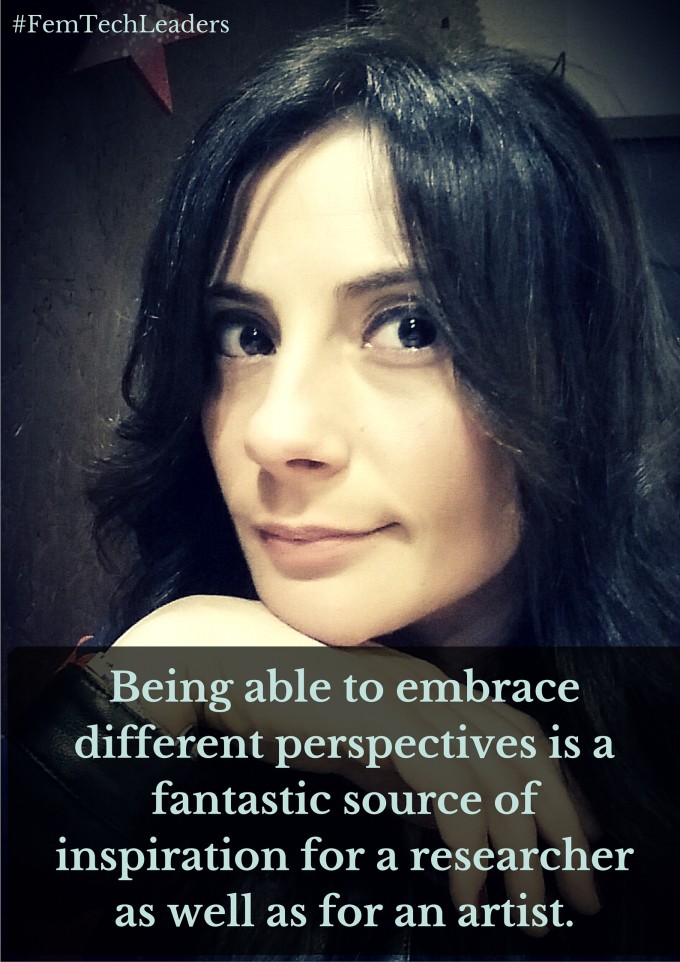
One of my favorite quotes by Ken Robison states: “Creativity is putting your imagination to work, and it’s produced the most extraordinary results in human culture.” Being able to embrace different perspectives is a fantastic source of inspiration for a researcher as well as for an artist, and you can use all of your imagination and sensitivity for art, music, culture in general to improve new and useful ideas. I’m a painter and I write romances so I use my color to define everything, for example to develop a good power point presentation and my language skills to suggest some tricks in terms of impressive communication when I mentored the start-uppers.
What led you from Italy to Dublin? How different has the experience been as a researcher between the Italian and Irish markets?
I moved to Dublin for personal reasons and it was difficult for me to find an ideal environment to exploit at best my R&D skills and work experiences. I had to restart my career from scratch, and I became an IT Project Manager as this role matches well with my professional background. This proved to be a turning point for me. I think in Italy we have a lot of important and excellent centers of researches and R&D institutions (ex. IIT-Italian Institute of Technology) and I worked for some of them.
How accepting is a large, global bank such as Citi been with your role as a researcher?
Citi was improving its role in developing and leveraging innovation in different sectors of business, looking for disruptive solutions and ideas. A lot of Companies in Ireland focus on Financial Services have a specific Lab or R&D sector to develop innovative projects due to a specific budget allocation and a strong political support about that. So in Citi, the core activity for the Innovation Lab in Dublin embraces some specific areas (ex. Digital Money, Security, etc.) to be explored and enhanced. Citi is large and global and they have a lot of procedures and rules to be followed. This can make it difficult at times as a researcher in the fast and flexible way we approach innovation and research. I think this is one of the problems related to many banks and financial institutions everywhere: bureaucracy advances slowly and doesn’t match with the speed of R&D.
You’re a mentor for the startups in the Dublin space. What is it about this role that attracts you?
It was interesting to interact with young people full of ideas and eclectic background, ready to improve efficient solutions in different fields. They are the new digital generation, so they are prepared to deal with problems where they have to find useful solutions. Being able to communicate their ideas in a convincing manner is one crucial skill many startups fail to master. That’s why I spent much effort in advising them to develop their communication skills to introduce themselves, their team and ideas in a proper way, with some tricks for a good pitch in terms of body language, power point presentation, grammar, etc. It was a pleasure to meet smart individuals really enthusiastic about innovation.
You have an extensive research background outside of financial services. What lessons from outside of the industry do you apply in your role today?
R&D skills can be applied for any kind of company or sector because it’s a methodology you learn and a way to structure your work. My research background in different professional experiences has been able to improve my flexibility and my capacity to explore and analyze projects such as the Digital Money space with the same curiosity and competency of my experience in solar panels and alternative energy. It’s a question of R&D mindset in the end, and your attitude to nurture it and tailor it in various contests.
Do you believe your previous experience and role as a PhD researcher is a model for other financial services companies to adopt in product development?
Financial services companies should be competitive in terms of innovation not only to improve the efficiency of a process but to find new and disruptive solutions as this digital era runs fast. Simply put, there is no time for excuses based on old and traditional financial models. A bank, big or small, has to play the game of innovation better than anyone else. This also applies in developing a new concept of human resources models focused on new roles and responsibilities, where researchers, chief innovation officers, developers, IT people, designers, and creative minds in general have a central role. Diversity is the key. PhD is only a method to conduct good research and to speak the same language but it’s not fundamental: it could be one of the main resources a company should get on board in this new innovation game but the importance is in the capacity. As Einstein said, “to raise new questions, new possibilities, to regard old problems from a new angle, requires creative imagination and marks real advance in science.”
Who(m) do you believe has had the most influence with respect to your own career?
My father. He taught me to be creative and humble but focused on my goals. After his death I changed my path from academic perspectives to the private company space. This has been the big challenge of my life but I learnt a lot and I’m ready to explore again.
Who do you consider to be strong women leaders in the FinTech space?
I’m too young in this sector to know the women leaders involved but my source of inspiration in science and R&D is an Italian Nobel Laureate honored for her work in neurobiology, Rita Levi-Montalcin. She has received a Nobel Prize in Physiology or Medicine and I consider her an example not only for her ambitious perseverance but also for her creativity and humanity to be followed. This applies in the Fintech space to teach the future generation of new entrepreneurs. She explained that “Progress depends on our brain. The most important part of our brain, that which is neocortical, must be used to help others and not just to make discoveries.”
What do you see as the 3 leading future trends for FinTech?
Fintech is an interesting phenomenon in particular in our Digital Era and should be able to roll out all of its power and to build momentum in terms of technology improvement and new discoveries. In my opinion the 3 leading future trends for Fintech in Financial Services should be:
- Mobile, wearable and machine learning/robotic to improve UX experience and analyze big data focus on clients, increase speed of life and user friendly and reach more clients in a “social” way.;
- Blockchain technology for new e-payments and smart contracts to speed internal processes and procedure, engage new digital customers;
- Security and safety, for transaction, payments, clouds and to protect personal information in this digital era.
Roberta’s artwork can be viewed at Dreamingart.org

© 2015 | FemTech Leaders
Start the conversation