Kelli Shultz
Owner, Kelli Schultz Consulting
Board Director at Allied Payment Network
Advisory Board at Dragnet Solutions, Inc.
Co-founder & Director of Strategic Sales at Venminder (fka Digital Compliance)
Louisville, Kentucky
@kellischultz3 | LinkedIn Profile
So what have you been up to lately?
A little over a year ago I decided to step out of the sort of operating management roles I’ve held for most of my career. It’s been a breath of fresh air. I’m mostly in advisory roles, working directly with the CEO’s of early-stage companies in FinTech/FinServ. My focus is typically growth strategy, fundraising, scaling operational processes and user experience design and management. I have a particular interest in blending technology and service into superior solutions. I’m involved with a few great companies and as my schedule permits, I’ll take on select short-term projects, mostly for industry friends.
How did you come about working within the FinTech space?
I was raised in a hardworking, blue collar family. My father was the breadwinner, working in a hands on management role at a chemical plant. My mother stayed home with my sister, brother and I for most of our childhood. I went to college, but I didn’t know what I wanted to do and didn’t even understand what I would do with a “business” degree. It’s tough for those of us raised without direct exposure to the world of business to grasp. Where I grew up, starting and owning a business meant opening a small shop or restaurant. The concept of building businesses to grow to billion dollar companies or to sell just wasn’t something I understood.
I studied lots of subjects ranging from music to accounting to human resources/learning and development, but nothing sparked a flame. I earned so many credit hours, but no degree. My college experience was not traditional at all. I worked full time from the time I was 16 years old to pay for college and my independence. Funny looking back actually… I think my independence was the single most important thing to me at the time.
I was exposed early in my career, at about the age of 22, to the founders of a regional cellular provider through a project that had me interview each of them. I remember having this moment where it all clicked. I was fascinated that these people started this company from scratch. I interviewed the engineer who put the very first cell phone tower up in the state of KY with his own two hands, and you should have seen the pride in his eyes as he told me his story. It was at that moment that I knew I wanted to build something. I still didn’t know what, but that desire to create something bigger than my imagination would allow me to dream began to burn deep within.
With fire in my belly, so-to-speak, I went on about my business and with that same company went into sales. It was a REALLY great time to be selling cell phones to corporations, so I was making more money than I’d thought possible. Then, a friend called to tell me about an opportunity she thought was perfect for me. She introduced me to Dana Bowers, and my life was forever changed.
Dana was the founder of a small, pay-by-phone company that had just launched its first internet bill payment product. I didn’t have a clue about banking, payments or anything near the subject. I could not have been more ignorant on the topic. Yet, Dana & I clicked instantly, and I took a leap of faith and left my job to join her… for roughly 1/3 of my pay.
Little did I know we’d build that little pay-by-phone company into what became iPay Technologies, which sold to JKHY in 2010 for $300 million. It’s still amazing to me. We had about a 40% market share at the time of the sale and built the business nearly exclusively on channel partnerships who resold our solutions. (A little side note – apparently our name prevented ApplePay from continuing the “i” naming convention. We saw some early press that actually used the name “iPay” but it never got to market under that brand.)
Basically, it was accidental, or fate, or something like that. I wasn’t drawn to a booming industry that VC’s were chasing, I didn’t know what it meant to sell a company, and I wasn’t educated or experienced in banking. This truly was a “follow your gut instinct” move. Over the years I’ve been told I have good instincts, and I guess looking back, maybe that’s true. I’m learning to trust them more.
You’ve helped establish multiple companies / start-ups throughout your career. What are the two or three key mistakes founders repeatedly make in the early days of establishing their company?
- Building too much too fast
- Chasing too many ideas at once (read: lack of disciplined FOCUS)
- Refusing to accept failure and move on (fast enough!)
- Not getting direct enough in getting client feedback (too many surveys, not enough conversations)
What are some of the priority areas individuals should focus on when co-founding and or partnering to launch a company?
This is an interesting one for me as I’ve not yet been in a situation where I really considered it at the onset of the launching. You see, I was sort of in the right place at the right time, and willing to roll my sleeves up and do whatever I needed to do to earn the opportunity to BE a co-founder, but I was not the one with the original idea of “hey, let’s start something”. I was the willing and eager student who grew into an understanding that I am, at heart, an entrepreneur. Again, my journey has been far from traditional!
That said, I have some pretty strong opinions on areas to spend some serious time discussing with a potential co-founder based on my own experiences.
- Decide upfront who is good at what, divide decision-making responsibilities accordingly and honor these when you have a difference of opinion that has you at an impasse with your business partner. There will (and should) be times when you don’t agree, so it’s important to agree early on how you’ll deal with these conflicts. Also, genuine, mutual respect is an absolute must. If you don’t have it, just don’t do it, period.
- Choose a co-founder that matches your own intensity level, but who has a skillset complimentary to your own. Some overlap is good, especially in the right areas, but it helps to have a broader combined skillset, especially until your company is large enough to hire executives to fill the gaps.
- Be sure to talk about and agree on things like how you’ll fund your growth, culture of the company, leadership and management style and what each of you want to get out of the business. It’s tough when one founder is looking to establish more of a life-style business and the other is looking for a windfall from the sale of the company at some point in the future. Too much distance in any of these areas could mean that while it might make sense in 9 out of 10 ways for you to partner, that one difference is enough to limit your successes.
You often mentor and speak to younger women concerning careers in the FinTech space. What take-aways do you normally focus on when working with them?
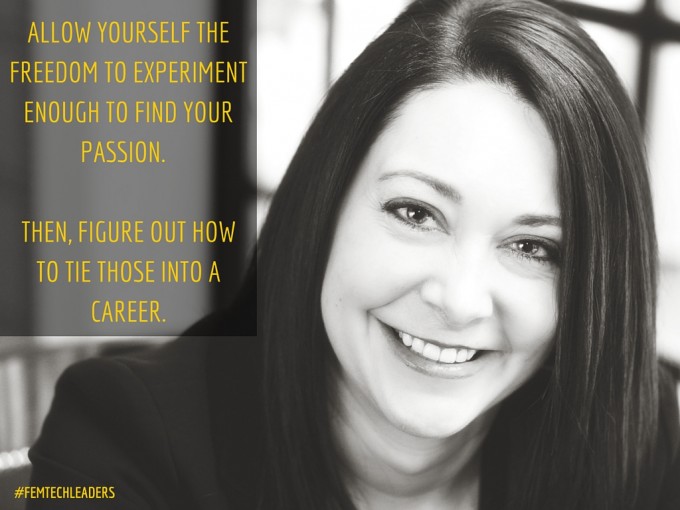
Our young people today are under such enormous pressure to go into college knowing what career they want to pursue. Reality is that most of us don’t know who we are at 16, 18 or even 25. We have to get out into the world and live a little before we discover what really makes us tick as individuals. I encourage young people to allow themselves the freedom to experiment enough to find those passions. Then, figure out how to tie those into a career somehow. Most of us aren’t born knowing what we’re meant to do, and that’s more than okay! High school, college and even our early career days are all about figuring that part out.
I spend time talking with women, particularly, on the importance of a foundation in STEM subjects. My goal is to help them understand how these subjects apply to building products and businesses, analysing data to make better decisions and just generally provide us with a more structured way of thinking through solutions to a complex problem. Many shy away from these subjects because they don’t see the applicable value in where they see their careers going. For example, someone who wants to pursue a career in marketing may assume someone else within their firm will hold these skills. While that may be true at the “tactical” level, my experience has taught me the value of having this foundational knowledge as a leader and manager. I’m more effective managing projects and people where these skills come into play because I can speak the language and understand the general possibilities. Being able to ask the right questions as a leader is crucial in a company of any size or market. So, helping women comprehend that STEM subjects equip them with the “legos”, if you will, that allow them to build out their dreams puts things into a much clearer perspective.
What do you see as the 3 leading future trends for FinTech?
- Simplification of everything user-facing. Smell test – Can I, or how could I do that on a watch? We’ve truly over-complicated SO many things. The market is dripping with opportunity to simplify the user experience.
- Machine learning applied to banking. I’m very interested in this new technology and its applications to FinTech.
- Relationship management reinvented. We’re only scratching the surface in making electronic touchpoints “human”.
More about a few of the companies I’m helping to grow:
Allied Payment Network removes the barriers of data entry on mobile devices through utilization of the smart phone’s camera feature. Led by a desire to improve the user experience in the mobile banking space, Allied’s flagship product, PicturePay®, combines technology and service to deliver the industry’s highest quality deployment of a mobile photo bill pay solution. Allied offers a complete line of payment solutions for the banking industry.
Dragnet Solutions, Inc. provides real-time identity verification and account screening solutions that enable organizations to segment and sell to customers based on profitability and risk, to improve the customer experience by streamlining account onboarding, and to enter new markets strategically and profitably. By analyzing applicant data and providing real-time product selection guidance, Dragnet Solutions enables organizations to confidently say yes to more account applicants, including applicants with limited financial histories. The company is based in Novato, CA.
Venminder, aka Digital Compliance, is uber-focused on solving the vendor management challenges our industry faces. Community banks, credit unions and the vendor community itself are all highly dependent on a network of third-party service providers. Managing this level of (necessary) outsourcing is complex, requires certain expertise and is mandated by regulatory authorities. Venminder provides an artful blend of software and services to fit the needs of most any financial institution.

Join the conversation
© 2015 | FemTech Leaders
Cyntha Adcock - 3 months ago
I graduated with Kelli! I’m not surprised by her accomplishments!!!
Marsha Kerr - 3 months ago
I ADORE this woman!! Kelli Schultz, this is an absolutely brilliant article! I don’t know how old you were when I first met you at iPay “way back when”, but you looked (and still do) like you were about 20 years old - yet had the mind of an executive that had been in the business for centuries! Back then, you gave me some great discussions and reading this article just now I felt like we were having a cup of coffee together.
Patti Wubbels - 3 months ago
Love this story Kelly! My 16 year old is in the midst of trying to figure out what life looks like after high school. So I appreciate your candid experience and plan on sharing this with her! Pleasure to have crossed paths with you.