Elizabeth Lumley
London Managing Director at Startupbootcamp FinTech, co-Managing Director and co-founder Startupbootcamp Insurance at Startupbootcamp
London, England
@LizLum | LinkedIn Profile
Startupbootcamp FinTech is one of the only accelerators in the world dedicated to FinTech startups. We are part of the global Startupbootcamp family, which is a highly respected startup accelerator with 11 accelerators in eight locations.
Since we are dedicated exclusively to FinTech we can offer advice, mentorship, networking, contacts and funding options that are all tailored to the financial services industry. When our teams get closer to funding rounds – our VC and Angel network are people who intimately know and understand this space.
We also operate on a collaborative model. Our partners include Lloyds Banking Group, Rabobank, Intesa Sanpaolo, MasterCard, PWC, Avarto Bertelsmann and Route 66 Ventures. A major part of our programme is helping our startups work on projects and launch pilots with our partners.
I am the managing director of the FinTech programme here in London. FinTech was founded in London in 2014. We now have a programme in Singapore and will soon be launching one in New York. I run the London programme and work hands on with the startups as they progress through the accelerator. I also serve as the spokesperson for the organization.
Please describe your ‘journey’ from the U.S. to the UK. How do you find the cultural and/or work environment to be different?
I arrived in London in 1997 when I was 25 because I thought it would be fun to work in London ‘for a year’. That was 18 years ago! I haven’t found many differences between the financial services industry in New York and London. However, I feel that London offers a more well-rounded environment of financial services opportunities. New York is very capital markets/investment banking heavy.
I think London also offers a better work/life balance than New York. I am not really arguing one environment is better than another. But you tend to work more (and not necessarily better) in New York. In London you work hard – but more people recognise the need for a life outside of one’s career. Whether it be ‘having a drink in the pub’ or stepping back for a few years to start a family.
Mind you, this is not based on any hard data or scientific research (just my own experiences and observations) – but people here in London are much more relaxed about revealing their personal side at work compared to New York. In New York, you have your personal life and your work life – and they are separate. Life is more relaxed here – which is strange to say about London, because compared to Europe (and even other parts of the UK), London is considered very intense. However, I’m comparing London to New York, so…
Is it an advantage being a female expat in the London / EU tech scene?
Ha! You never have to wait to use the ladies room at conferences. Being an expat does have its advantages – and not just being a female expat. When anyone stays in their ‘home town’ so to speak, you tend to get constrained by indigenous rules. When you leave, and become the outsider, you no longer feel hamstrung by both the ‘rules’ you grew up with and the ‘rules’ of the place in which you now live. For example: many places in the UK (not many, but some) would still judge you as an employee based on what public school you attended. As an expat that doesn’t even matter, so you don’t get judged by the same rules as a native.
That said, there is a cultural stereotype that all Americans are straightforward, a tad aggressive and loud. As a woman (who at times can be straightforward and assertive) you get a bit of a pass or maybe don’t feel as much pressure to conform to (outdated) ideas of how a female is supposed to behave. Again, no scientific evidence here, but I feel chauvinistic attitudes much more acutely in the U.S. than in the UK and Europe. No one in UK or Europe has ever called me ‘lady’ or ‘dear’ for example. No one here has ever asked me to ‘speak up, dear because I can’t hear ladies’ voices. I also think I am ignored by men in meetings and interrupted by them (two major ‘everyday sexism’ activities) much more in the U.S. or when I am dealing with American men, than when I am dealing with UK and European men.
How have you seen banking change with respect to its attitude and approach to tech over the past decade?
Huge. huge change. The biggest change in attitude began about three years ago. I believe it’s a combination of several factors. Banks are a major buyer of IT, and attitudes to buying IT are changing. Many banks are questioning why they are paying thousands of people from IT contractors to sit inside their offices. Is this the most efficient way to deal with IT?
Changes in tech over the past few years – open source, cloud, opening up APIs, digitization of products – have opened up technology in general, which has also influences customer behavior. For example, what if a bank wanted to launch a mobile product, but chose to build their own telco network, handsets, OS etc. That would be ludicrous! The way tech ecosystems operate in 2015 have forced banks to work in a more open way.
Yes, when I started writing about banks and IT in 1994, banks wouldn’t even tell me if they had PCs in the building (competitive advantage) – a few were even trying to build their own operating systems. That world has changed. Banks still do some silly things in regards to IT – and in some ways they need to deal with IT is a different way because they are a ‘different [regulated] beast’ – but they aren’t stupid. The world changed and they changed with it.
What is your own perspective on the London FinTech scene. Is it the world leader?
Yes, we are the global capital of FinTech. That is not an opinion. Next question!
Seriously, I would say that no other city has every facet of financial services – buy-side, sell-side, retail, corporate etc. – and the tech talent and investment opportunities that London does.
In addition, the UK government and the regulators (FCA and PSR) have made huge efforts to ensure London and the UK are easier place to do business, get investment and set up financial services tech firms. They are making it a simpler process to get a banking license. They offer e-money licenses to those who don’t need a banking license and they are working hard to ease access to the Faster Payments platform. These issues had previously been barriers to entry for new players in this market.
Please discuss your women in tech ‘wake-up call’ from a few years back in Barcelona.
I spent six years as an editor at Finextra. I put together content and speakers for a myriad of events. We ran a one-day mobile banking conference in Barcelona in 2012 with at least six panels and two main presentations.
When we got to the end of the day, before the drinks, I thanked everyone for a great day and slowly realised, that if you didn’t count me, the host, there were no women on stage – all day. Not one. And no one commented on this. Imagine if you went to a banking/tech conference and there were no men on stage – all day. It would make the evening news! But a parade of (usually, white, middle aged) men speaking is seen as ‘normal.’ That should not be ‘normal’ in any industry – male-dominated or not. When you only see one type of person giving their insights, or when only one type of person is allowed to voice their views, it creates an echo chamber in which no progress happens, nothing improves and there is no innovation.
This goes beyond feminism. This isn’t a political agenda. The financial services industry needs – desperately needs – new ways of thinking, and the easiest way to do that is to create diversity in experience, thoughts, opinions, research and visibility.
At Finextra, I decided to make it a point to get more women on stage and in videos and webcasts. And when I started thinking about it, I never had any trouble finding senior, capable, outspoken, knowledgeable women. People who claim that ‘they are just filling speaking slots with the best people we can find, regardless of gender’ are really just filling the slots with the people they know. And if you are a white, middle-aged man you tend to know a lot of white, middle aged men.
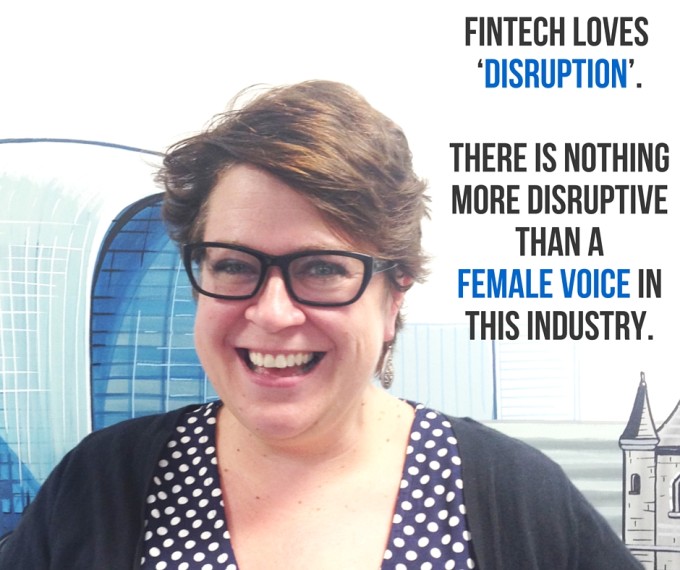
It’s my catch phrase now. This industry loves ‘disruption’. There is nothing more disruptive than a female voice in this industry.
What do you see as the 3 leading future trends for FinTech?
Two years ago it was payments. Last year it was loans. This year it is asset management (we have five firms in that space this year – BondIT, StockViews, Delio,Obsidian Solutions and Walnut Algorithms). Next year it will be Insurance. with companies such as Tradle. WoraPay, Cybertonica and MoneyFellows.

© 2015 | FemTech Leaders
Start the conversation