Sophie Guibaud
Vice President European Expansion at FIDOR Bank
London, England
@SophieGuibaud | LinkedIn Profile
Founded in Germany in 2009, Fidor Bank offers a different experience- a ‘people’s bank’ that is redefining the classical banking model. Customers have a say in how the bank is run and shaped. Fidor is an online bank that offers a community for people to provide and receive financial advice, giving users rewards for doing so such as cash, improved interest rates and savings bonds. Fidor is also known for integrating third-party financial services directly onto its platform, such as crowdfunding or P2P lending options, to offer a wider selection of banking options for its clients.
Fidor Bank has received several international awards for its disruptive approach to banking, its FinTech activity and innovative use of social media. Recently, Fidor Bank was awarded “Global Growth Company” by The World Economic Forum and Celent Banking model of the year 2015.
Fidor is an interesting case study as an alternative banking Do you believe the UK and for that matter the U.S. consumers are open to this type of engagement model?
In recent years, customers have become much more autonomous due to the emergence of specialised social networks and mobile tools, which has raised the bar in terms of customer service expectations, making consumers able to choose the right products that correspond to their needs. They want the future of banking to change towards a more digitalised approach, offering better, cheaper and faster services and products adapted to their needs.he current banking system has failed to provide this so far, due to their heavy legacy core banking system and more stringent regulations arising from repeated financial crises.
Fidor’s proposition to involve our retail and corporate customers in the bank’s creation process continuously has already attracted 300,000 users in Germany, proving that people are interested in new banking propositions. We’re letting people share their financial know-how and experience in the community and incentivising them to do so. We’re providing them a wide range of financing and investment opportunities by integrating Fintech partners offers such as crowdfunding opportunities, P2P, currencies, and precious metals.
Our secret recipe lies in the community. We ask our customers what they want instead of offering them what the bank wants or what the bank thinks they want, ensuring the customer centricity of our services. It proves Fidor’s openness, transparency and accountability towards our customers needs and our commitment to develop a trustworthy relationship with them.
You are a very active mentor in the London UK scene and are involved at Level39 and Startupbootcamp FinTech among other organisations. Why does mentoring startups mean so much to you?
Mentoring startups is important to me for 2 reasons:
First of all, it is very rewarding to be able to give back to young people, especially as I received help when I started out. Young entrepreneurs are the reason our industry is so dynamic, simply because they are eager to make things better for consumers and improve inefficiencies within the industry. Helping out is a good way of directly contributing to the future of the industry.
Secondly, a more personal reason for mentoring startups is that I really enjoy brainstorming new ideas and business models as it feeds creativity and helps me to remain at the forefront of the industry. Both of the organisations I’m involved in offer different programmes to startups which require different levels of involvement and types of mentoring. Startupbootcamp startups are often younger and need general strategic advice for a given period of time whereas Level39 startups need one-off or specific advice on a given topic. Both of them have high quality startups in their programmes and I am always very enthusiastic about helping.
You have an extensive background working at banking disruptors to include Fidor, Bankable, and KBC Bank. How much of an impact have these disruptors had to the current banking model?
All these experiences have brought me with a broad overview of how banking works and can be different from one type of organisation to another, whether it is in a large bank such as KBC, a Fintech providing payment solutions to banks & governments or a smaller bank.
Of course, these experience have proved me that smaller organisations are often more agile and therefore are driving innovation in the industry.
Fintech companies have developed very quickly due to the gap between customers’ expectations in a digital environment and the lack of products adapted to their needs offered by traditional banks. These Fintech and new type of banks have been focusing on filling in a need on the market for customer centric products and new business models by either focusing on solving a global or niche market need. It has impacted the market in several ways of which:
- Improved business models (cheaper or more flexible pricing – international money transfers,…)
- Developed cooperation between banks & fintechs for improved offering to customers (in white label or through referrals)
- Development of financial services offering targeted to the specific needs of niche segment underaddressed by banks in the past (children, SME, expats,unbanked markets).
I believe the arrival of such young and disruptive organisations on the market had and will have a massive impact on how the banking industry works and its users’ everyday life.
What do you believe makes London so unique as a startup hot-spot?
I believe London is a hot-spot for launching startups due to the proximity of talent and investors.
Furthermore, London benefits from the support of incubators and accelerator programmes as well as strong governmental support to help startups flourish.
This is all the more true in the Fintech sector with multiple industry as well as bank’s initiatives with StartupBootcamp and Barclays Accelerator designed to support new startups. Furthermore, Level 39 has created a centre of Fintech excellence, where you can reach out to multiple industry actors at the same time.
London is really unique especially in terms of trade bodies such as Innovate Finance, the government support of the UK Fintech 2020 manifesto and the appointment of Eileen as UK Treasury’s “special envoy” for Fintech. This definitely makes London the place to launch a Fintech startup.
Several countries in the Nordics have introduced quotas with respect to the number of women serving on company boards. Do you agree with this approach?
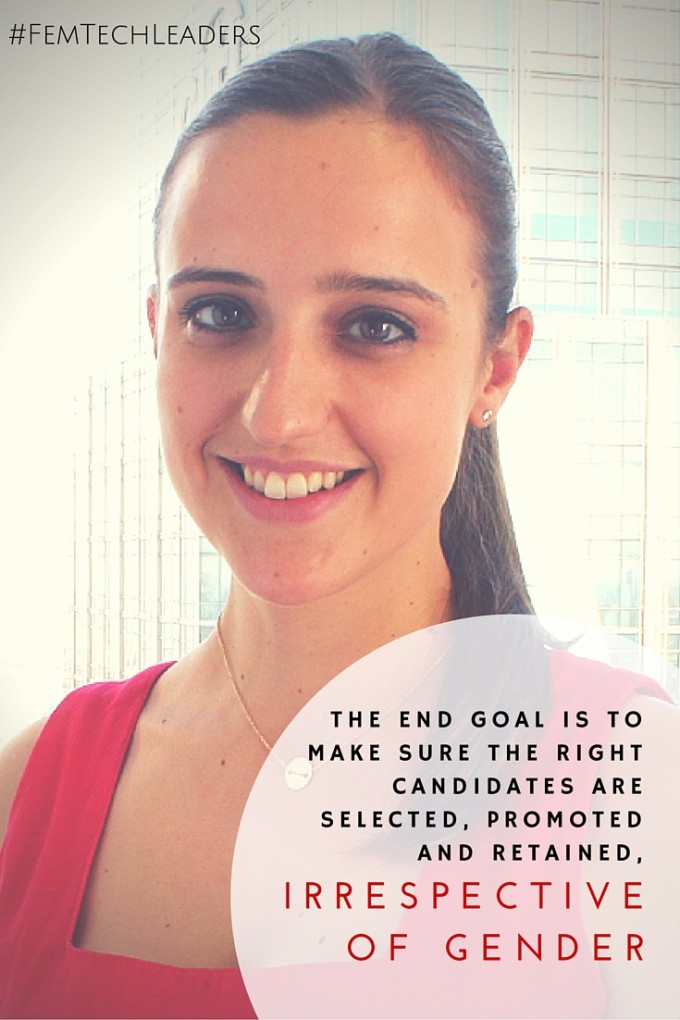
Although quotas are showing the willingness of governments to address the gender gap problem, I personally think that a better way of addressing the issue is through education in the workplace, whether employees are entry level or more senior with recruitment responsibilities. Employees, men or women, not only need to learn how to identify and correct the potential bias they are exercising towards women but also need to understand the benefits of working in a gender balanced environment. Ideally, education should even start at school in order to address this challenge globally. The end goal is to make sure the right candidates are selected, promoted and retained, irrespective of gender.
Who do you believe has had the most influence on your own career?
My parents have had a great influence over my career by always supporting me in my endeavours. From when I left home at 18 to do my undergrad in Canada, to moving to Italy to study at Bocconi University without speaking a word of Italian, or when I decided to move to the UK just 3 days after being recruited by Rocket Internet for their UK launch.
Secondly, my mentor from KBC Bank, Stephane Monnier, has been a great support throughout my journey, not only through being a great connector by putting me in touch with the right people but also by being such an amazing source of advice.
Who do you consider to be strong women leaders in the banking / FinTech space?
I wouldn’t like to mention just one person but rather all the great ladies working in FinTech in London that have contributed to its development over the past few years:Jess Williamson from Barclays Accelerator, Edwina Johnson and Liz Lumley from Startupbootcamp FinTech, Adizah Tejani from Level39, Marta Krupinska from Azimo, to mention but a few… It’s a long list! We are all passionate about improving the sector and hope it will inspire other young and experienced women to join us in doing so.
What do you see as the 3 leading future trends for FinTech?
Among the numerous upcoming trends in FinTech, I would mention:
- Banking as a lifestyle experience, not a commodity: enabled by the use of client’s data for an improved and fully personalised experience.
- Banking API: In light of European PSD2 regulation enforcement by banks, independent providers will be able to make attractive, easy-to-use services that help customers truly transform their finances.
- Blockchain technology: The blockchain has the potential to disrupt the financial services industry in a number of areas, eg. within cross-border banking, as it could potentially cut down on cost associated with settlements by introducing a decentralised ledger. The cost and efficiency savings could be enormous.

Join the conversation
© 2015 | FemTech Leaders
Patrick Restrepo - 6 days ago
Great Interview!