Kim Hong
Director of Marketing at Trulioo
Vancouver, Canada
@TheKimHong | LinkedIn Profile
Trulioo is a global leader in electronic identity verification (eIDV). Trulioo’s big data and analytics platform enables businesses to perform frictionless identity verification for more than 3 billion people in over 40 countries via 145 data sources. Built for scalability and flexibility, Trulioo’s API offers dynamic new functionality that will help facilitate international expansion for businesses worldwide.
Helping businesses adhere to anti-money laundering (AML) and Know Your Customer (KYC) compliance requirements, Trulioo’s mission is to solve global problems associated with verifying identities online by powering fraud and compliance systems for hundreds of clients (including Kickstarter, Stripe, Square, and PayPal) worldwide in an effort to increase trust and safety online. Trust is what has and always will connect us as humans, and at the heart of it all is verified identity.
How important has the support system of your family been with respect to your personal career success?
My parents have been an integral part of my success. They sacrificed everything (family, friends and their lives) for the mere glimmer of opportunity for prosperity, success and a better life for their family.
I was born in a refugee camp in Thailand. My parents were part of the second wave of refugees after the Vietnam War and later were sponsored to live in the U.S. Without a birth certificate or any form of ID, my parents arrived in America with nothing more than a suitcase filled with dirty
clothes and an extra mouth to feed (me). They had no money and no credit. They were issued a Permanent Resident Alien “green card” by the government and received financial aid to help them get immediate and essential services. My father worked long hours at an Asian supermarket while my mother took ESL classes at an adult school and took care of the family.
You can probably guess where I’m going with this: they are the epitome of the “American Dream.” My hard-working immigrant parents were given the opportunity to achieve prosperity and success. They instilled values in me that reinforced their belief to always “live within your means” and not spend money you haven’t yet earned. They paid bills on time, saved and saved and ultimately decided to open a family business in the early 90s. With access to financial services and literacy, my mother understood how to earn interest, establish good credit, and eventually take out a business loan with low interest rates.
Without their hard work, support, financial literacy and strong values, I would not have the opportunities to success that I do. My parents vowed to give their children a better life, and my professional success can be attributed to their selfless commitment.
What attracted you to work in the FinTech space?
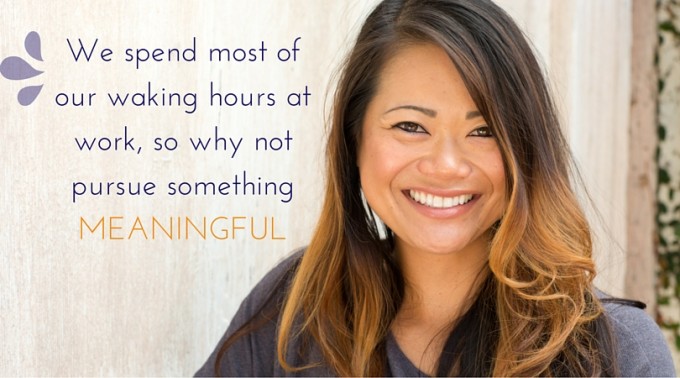
I’ve spent over a decade at public relations and marketing firms of all sizes, but always found myself feeling unfulfilled and empty at the end of the day. I was quite satisfied with the teamwork aspect, but I wanted something that would give me a sense of purpose. After all, we spend most of our waking hours at work, so why not pursue something meaningful in your work?
FinTech combines two things that I’m passionate about: financial inclusion and technology. I began my career in PR long ago, but being an early adopter of social media gave me insight on how the Internet would not only affect my personal life, but also the world of media consumption. I had a hunch this new technology would forever change how we communicate, consume, behave and think – leaving the door wide open for innovation. Financial inclusion holds a special place in my heart because it promises opportunity for those who were born into a situation, circumstance or environment that makes it impossible for financial empowerment and results in a cycle of poverty. If I can be part of something that offers a level playing field for everyone, I’m all in. My immigrant parents were blessed with the opportunity to start a life in America where they received access to basic financial services. With hard work and time, they were able to lift themselves out of poverty and become successful entrepreneurs with a better quality of life.
You’ve transitioned from San Diego, San Francisco, Santa Monica, and are now an expat working for Trulioo in Vancouver. How would you describe the differences between the four cities with respect to the tech / startup scene?
So many cities are trying to be the Next Silicon Valley. From Silicon Valley North and Silicon Beach to Silicon Alley and Silicon Coast – there are countless cities attempting to co-op a Silicon Valley related nickname.
Forgive the generalities, I would describe the San Francisco tech startup scene as an airtight bubble consisting of consumer-focused technology, whereas Vancouver startups consist of B2B-centric technology. My hometown, San Diego, is not an ideal city for tech startups. Although it’s a beautiful place to live with perfect year-round weather, it’s not the place to me if you’re looking for talent, capital and customers ( hence, my decision to relocate). I’d say the tech startup scene in Santa Monica is fixated on media and entertainment (for obvious reasons, e.g. Hollywood) and the pace is much slower than San Francisco, but you’ll find lots of startups backed by celebrity patrons, partners and investors – which translates to faster adoption and greater distribution! Star power can go a long way in this industry.
During our discussion you noted the challenges for expats to establish credit in a new country. Do you believe FinTech can be a driver of change for this issue?
Fintech is 100 percent the driver of change for expats who are trying to establish credit in a new country. If the banks can’t come up with a way to help someone like myself (with exceptional credit and no debt) establish credit, there is an abundance of FinTech companies who can and who are currently disrupting the banking industry with customer-centric products, alternative credit scoring, instant online identity verification, data analytics platforms, and mobile payments (just to name a few).
What advice would you provide younger women interested in a career in FinTech?
Younger women interested in a career in FinTech should take a proactive role. Join professional organizations and show up for meetings, participate in online discussions related to FinTech, reach out to female leaders they admire and express their interest in following their footsteps by demonstrating initiative and grit. There are a countless number of mentorship programs available, including Women in Leadership, Women Guiding Women, SOUL, and Women Unlimited. Be resourceful and conduct your own research for mentorship programs that best suit you and your career goals.
Why do you believe it is important that more women become involved in FinTech?
With more women in FinTech, we will see more solutions geared toward solving third-world problems, rather than first world problems. With more effective communication, compassion and global perspective, women can bring a great deal of introspection to the FinTech table.
What do you see as the three leading future trends for FinTech?
Mobile payments, crowdsourcing, and the collaborative/sharing economy.

© 2015 | FemTech Leaders
Start the conversation