Harriet Wakelam
Head of Customer Experience at Medibank
Melbourne, Australia
@hwakelam | LinkedIn Profile
Medibank is celebrating a new generation. Generation Better shares the belief that better health leads to better lives.
As Australia’s largest private health insurer we cover more than 3 million Australians. We’re improving the way we do things to help all Australians achieve better health.
Our relationships with providers mean we can negotiate great deals for our members. Our Members’ Choice network is one of the largest health provider networks in Australia, covering most private hospitals and more than 8,000 extras provider locations.
At Medibank our core business is the underwriting and distribution of private health insurance policies through our Medibank and ahm brands.
Medibank focuses on the affordability of health. This make it possible to think about ways in which people can be healthier, health systems can work differently and insurance premiums can be the source of security about health.
I am the Head of Customer Experience. My role is to use human-centred design to influence and transform the interactions and experiences our customers have when working with Medibank. I walk the line between fluffy and meaty to understand what is human, what is real, what is data driven and what might be… and then to build and test solutions that transform experiences.
You’ve had the opportunity to work in Eastern Europe including Russia, Australia, and other regions. What do you think are some of the distinct differences among them with respect to design approaches (strengths / weaknesses)?
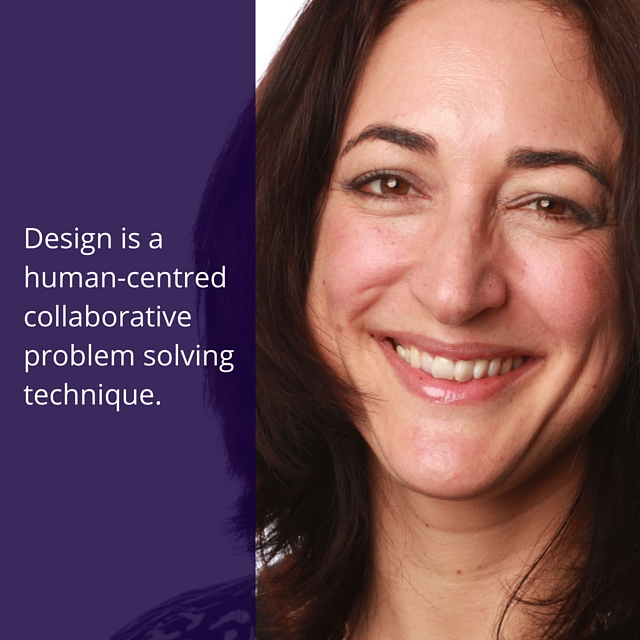
Design is a human-centred collaborative problem solving technique. Therefore the types of humans involved in the problem solving change the solutions that emerge. That is what makes it fascinating to work in different countries. It is the beauty, the potential and the challenge of great design. If we take design to work across what is true (data) and what is real (context), and then design for what is ideal (adequate versions of the future) – then the banking solution for Russia will emerge as the optimal version for that culture. The solution for Russia can then be run through a design process to identify the transformation required for say Australia. I am endlessly curious about the ways that people use things and my experiences in other countries have only fueled this further.
You mentioned Australia as being ‘maverick’ when it comes to design as they don’t have the design tradition as compared to other regions. Can you elaborate?
Countries such as Europe and the U.S. have a long academic and practical history of design. Australia also has a strong history of design, but it is much more aligned to the ‘maker’ space. Take for example the Chisholm Ryder Grape Harvester. Australian innovators sourced an American prototype, brought it back to Australia and, through great experimentation, produced the most efficient mechanical grape harvesting in the world, thus launching the rise of the Australian wine industry. This ‘tinkering’ culture lives on to some extent in design – look at the Commonwealth Banks’ innovation in the mobile space. This willingness to try new experiments that sit outside of traditional development pipelines has created success above its weight.
The service design/human-centred design community has attracted a very diverse group of thinkers and tinkerers – unencumbered (and unstructured) by design practice or theory – including mining engineers, psychologists, artists and business improvement experts, as well as the more traditional disciplines. This has its challenges – with a tendency to follow the models and fashions of international design a little too devotedly. However, it has also a design culture that more closely resembles a ‘renaissance’ community of ‘adjacent possibility’ (Johnson) than the more elegant design cultures of Europe and the U.S.
The opportunity is for us to harness this wildness of the maker culture through creative design leadership and organisational change. The risk is that we fragment ourselves through our multiple stories.
Your approach to design is the intersection of tech and human moments. Can you elaborate on this concept? How does this drive your approach to user experience and design?
Experiences are made up of interactions. To move successfully from one interaction to another you have to immerse yourself in the interaction and then move into the next one. This process is both a human and a technology one. It has to move seamlessly from a technical point of view – i.e. the form needs to submit smoothly, the data transfer, the feedback make sense – but it also needs to feel seamless. Often designers and engineers get lost in the beauty of the design of one or other of these, and the transition into the next interaction becomes bumpy. Think about signing up for Apple’s new iMusic – the first thing you see is a pop-up telling you that audiobooks has moved – relevant, sure, but in this context? It’s a technical prompt made in an inhuman fashion.
How does this influence me? I believe the execution of design is in part about the careful selection of the team that will design the experience. Designers, engineers, business leads all need to work in messy collaboration to build human experiences supported in amazing ways with brilliant technology. It is also about the purposeful design and build of experiences using simple frameworks. A good framework moves beyond governance, supporting teams as they move outside their comfort zones – going beyond solution and designing for something new.
Who do you look at as examples of products in the market that ‘get it’ when it comes to the human element?
Evernote – although sometimes it confuses the hell out of me. It does just the things I need it to do and allows me to have random moments of pleasure when I discover things I didn’t know about. Kickstarter for the joy of exploration and possibility – but then the ability to randomly purchase new ideas in way that delivers gratification. Guevera for making me want insurance. A Dualit toaster because that lever feels amazing – I could push it up and down forever. And Bubble Wrap – how good is that?
Your father was an industrial designer and you gave the multiple kettle story (“why did you choose that one?”). How big an influence has he been to your design approach? How important do you believe these early influencers are on individuals, especially young women with respect to engineering / FinTech?
I chose the kettle one, but I could have chosen the hairdryer one or the car mirrors. My dad had an insatiable curiosity about how and why things worked (he taught me about affordances before I knew what they were). The kettles were about beauty as well as function. He wanted to know if it was the colour, the curve, the weight or proximity. He knew that people use things for rational and emotional reasons and never stopped wondering why. This is at the heart of the way I use a very different form of design in my work. If something doesn’t make sense or is too complex, then it deserves investigation. I use the terms ‘design squiggle’ and ‘design fog’ often. If it is complex and doesn’t make sense, then keep questioning, keep investigating. Are you missing a data set? Where is the gap? Is your story right? This is how my father influenced me.
I think we are losing the art of mentorship as a means to grow creativity. In our culture of idea worship we run the risk of holding back our best advice because we fear that someone becomes better than us. I am deeply uncomfortable with the idea that women need different support than men – even though personally and through the women I work with, I know that self-doubt is a real problem. We need to ensure that young designers/engineers/entrepreneurs get to work in real and messy ways with mentors and influencers. Many of the best lessons are learnt through practice.
You used the term ‘purposeful experience.’ Can you elaborate on this.
Our current business and education environment conditions us to provide answers. Ask a question and provide an answer. While this is appropriate in many situations, in times of transformation there is a need and an opportunity to create something new — to bring something into the world that previously did not exist. In this environment solution thinking is not appropriate. Creation and design are mechanisms that bring about the new. However, for new creations to be meaningful, humans need to connect with why and what is being designed. This is what I mean by purposeful.
The purpose is the driving force, the essence of the way the story is told about what we are designing. It is the thing that inspires people, moves people, and helps people believe that anything is possible. Purpose is the way we articulate the ‘why.” It is the alignment of brand, experience, business, humanity and technology. Purpose helps align the inside and the outside. Many projects fail to design purpose at the start, which means that a team can never really become engaged enough to bring their inspiration in to the project. And a project without inspiration and purpose is like toast without butter…. IMHO.
“We fell in love with the shiny” was a phrase you provided concerning UX and CX. Have we learned our lesson?
Nope. We are stuck in a paradigm of shiny is sexy and experience is seen as obvious until it changes the world – then it is viewed with jealousy. It’s a maturity thing. We are teenagers in the world of tech parties (ducks and hides).
Can you elaborate of the intersection of health and wealth?
It is simple. Health and wealth are fundamental needs of life. Facilitated by education, these services enable us to be providers, lovers, inventors, supporters, partners, transformers and citizens of the world. Access, literacy and equity in the provision of health and wealth can do more to transform our society than any other services, yet we cloud them in goals, structures and language that make them expensive and inaccessible.
FinTech has seen us start to experiment with new access to services and the provision of financial literacy in new ways. HealthTech has seen us gain new insights into our health and wellness, but only for those that can afford it. Imagine a world where health and wealth were services that all could access. Imagine the innovation we could unlock. Imagine if we could set a velocity for our health and wealth that enabled our success – wherever we were born and whatever our circumstances.
Who influences you? You mentioned Joyce Kim from Stellar and the metric that 80% of health issues could be addressed with $2 or less in savings. Can you expand on this ?
When you look at the initiatives of organisations such as the Bill and Melinda Gates Foundation through to Stellar, you see a stark IFC connection between health and wealth. In developing countries, many families start a downward slide from managing to poverty when a breadwinner gets sick with a disease that is preventable – and oftentimes eliminated – in the West. The Bill and Melinda Gates Foundation has identified 18 common diseases that it is actively working to eliminate as key triggers to poverty (http://www.gatesfoundation.org/What-We-Do/Global-Health/Neglected-Infectious-Diseases). Curing disease requires not only a health system, but also the ability of a family unit or individual to access financial services to support that health system. Too often the western banking systems require too high a barrier for entry, effectively locking out access to health as well as wealth. The advent of bitcoin, blockchain technologies and cheaper transfers and pipes puts affordable preventative health – and by default wealth – within the reach of a new market. This is exciting, transformative and purposeful. Companies such as Stellar are doing exciting work in this space.
I am influenced by brave thinkers: Melisse Nova, Harveen Narulla, Michelle Joy Gilmore, and Alberto Soroda.
What do you see as the 3 leading future trends for FinTech? What impact will CX have with respect to these?
Investment and funding will move beyond product into service funding; we will see our FinTech investment as pipes – the means to the delivery of things in new ways.
Service becoming sexier than technology, with this service being delivered through robust, intuitive platforms that amalgamate services and products into meaningful experiences.
How will CX help? We will use human-centred design tools to build frameworks to support the development of these meaningful services. We will support the growth of human. We’ll stop talking about blockchain and bitcoin and start talking about access, care and response” for example (did I mention that I’m an optimist?). To parrot Clay Shirky, the technology will become ubiquitous, and boring. The potential to redesign the world will become inspiring and drive the creation of new teams, businesses and propositions.
Who do you consider to be strong women leaders in the banking / FinTech space?
Wow, that’s the hardest question you’ve asked! The leaders that inspire me come from outside and inside the banking industry, and it is the intersection of their ideas that will create the future we need Joyce Kim at Stellar; Claire Calmejane at Lloyds; Duena Blomstrom for crazy, but inspiring thinking; Michelle Gilmore, director of NEO service design, for the amazing work she’s doing in rethinking the interfaces we use. I don’t think you can segregate literacy, digital and finance, so I’d add Martha Lane Fox, Lisa Gray, the ex-group executive of Personal Banking at NAB, and Kirsten Dunlop at Suncorp.

© 2015 | FemTech Leaders
Start the conversation