Claudia Chiaraluce
Head of CEE Learning & Development at UniCredit Bank Austria AG
@cchiaralux | LinkedIn Profile
Vienna, Austria | Milan, Italy
Can you please provide an overview of your role at UniCredit.
At UniCredit I covered multiple roles in areas from planning & control to innovation. I created “Idea Sharing”, the first internal online platform for ideas & best practices, I managed UniCredit Fintech Accelerator program and I led many initiatives to spread innovation culture.
I’m currently in charge of Learning and Development for UniCredit CEE Division with a focus on people development, talent acquisition and digitalization. I still feel so excited and proud of having faced at same time an international and a cross-functional move, from Innovation Dept. in Milan to an HR role in Vienna.
Your career began in consulting, and then you shifted to focusing on the realestate sector for UniCredit. How does this background shape your approach in working with both bankers and fintech startups?
Within business consulting path, I was exposed everyday to a different challenge, working on multiple projects, sectors and organizations, being flexible to customer needs and likewise being pragmatic and resolute.
When I moved to UniCredit in the real estate company of the Group, in addition to the consulting and problem-solver- approach, I boosted listening and networking skills to mediate and adapt to a pretty different culture and environment.
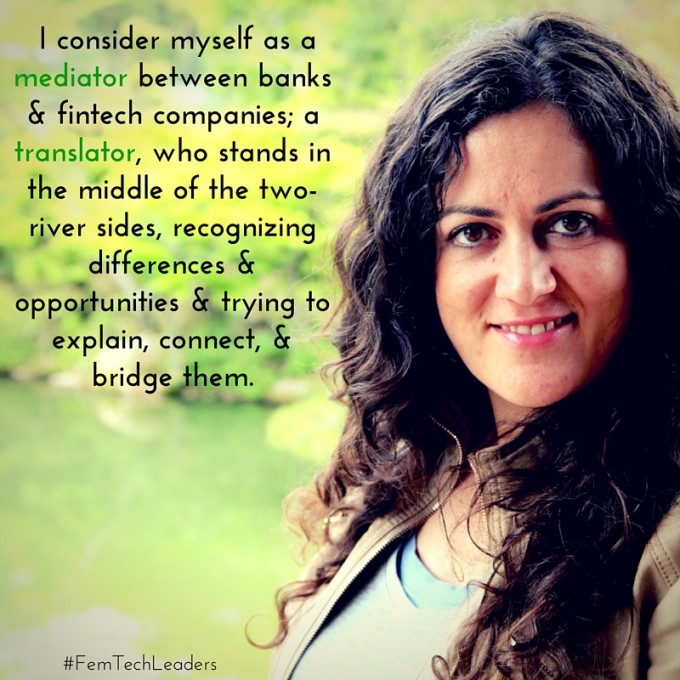
This ability to listen, rethink and restart helped me in working with startups. I feel their energy and passion, I love their freedom and I perceive their difficulty of interacting with complex and hierarchical organizations as the banks are. I probably consider myself as a mediator, a translator, who stands in the middle of the two-river sides, recognizing differences and opportunities and trying to explain, connect, and bridge them.
You were tasked with ownership of creating the ‘Innovation Enablement’ group at UniCredit. How did this come about?
After a few years of performance analysis and space optimization, I started to feel restless and I realized it was the time for a new challenge. I applied for an internal IT position and after 2 months I was asked to join the new Innovation Department with the aim of defining the new model and organization. It was amazing! Innovation has always been my dream and I could finally connect rationality with creativity.
After the set up of the Department, I became responsible of the Innovation Enablement team. This was the starting point of a splendid journey: how to involve employees in the innovation process? How to increase awareness on external innovations and new technologies? How to transform innovation in a key pillar of the corporate culture?
With courage and passion I promoted and led initiatives to enhance creativity, collaboration and participation such as: thematic innovation sessions to generate ideas in one-off events; online platforms to engage extended group of employees and customers in the key innovation priorities; communities to increase the engagement of internal experts in the testing phase and periodical Innovation news feeds to increase awareness on market trends and internal innovations.
At that point, I realized how important is people engagement to drive real changes in the organization and how challenging are the initiatives to spread innovation culture.
What was the innovation and fintech startup community like in Milano when you began setting up the team?
In 2011 the fintech community was globally in a very early stage, and above all in Milan. To breath the fintech energy and discover which big changes were happening, I flied to San Francisco and New York to attend the Finovate events, a unique opportunity to be exposed to the international cutting-edge banking and financial technologies.
The US trip opened my eyes, inspired and overwhelmed me with energies and ideas. I have a new vision on banking services. But the ground in Milan was not ready: mobile payments, online banking simplification and personalization, social trading and advisory … were not yet priorities.
As we know, the facts have confirmed this vision, it was jut a matter of time! Innovation needs time to take roots and pioneers have to challenge their patience and perseverance.
When, at the beginning of 2014 the corporate FinTech Accelerator of UniCredit was unveiled in an attempt to build industrial collaborations with startups, we were one of the first movers in Europe among banks. It was an exciting experience! Together with 3 fintech enthusiastic colleagues, I was involved in many diversified activities, from the design of the co-working space, the flow of the program … to the startup selection, the matching of the internal mentors and the organization of workshops, training and sprint sessions.
On top of the usual corporate banking life, it was a unique experience to collaborate and daily support 4 startups for almost a year in their own environment. One of them Quokky has been chosen by Apple as Most Innovative App of 2015 in Italy and as one of Italian most innovative solution presented to Tim Cook.
Furthermore, I enjoyed building interactions with the fintech ecosystem and promoting networking events in Milan to support the community growth. I reached the apical moment promoting the hosting in the UniCredit Towers of the brand-new FinTechStage conference. This was the first international fintech event held in Italy, open to innovators, startups and investors, and it strongly boosted the Italian fintech community.
How did you go about encouraging involvement with the Innovation team internally with the various business units at UniCredit?
A continuous big challenge! There is no perfect recipe and over almost 5 years in innovation I have experienced different ways to execute innovation. I personally think that a strong partnership between IT and business is crucial to transform good ideas in prototypes and lead them to the market. Agree on priorities, involve in the pilot project business people with a good understanding of customer needs and keep always a positive and collaborative approach.
But this is not enough, the hardest challenge is to increase awareness and collaboration among different functions, from legal, compliance to IT security. Talk, convince, explain … in a way that everyone can support change, applying new rules and procedures if needed.
During our conversation you noted “banks are more used to looking inward”. What did you mean by this.
“We’ve long believed that over time companies tend to get comfortable doing the same thing, just making incremental changes. But in the technology industry, where revolutionary ideas drive the next big growth areas, you need to be a bit uncomfortable to stay relevant.” said Larry Page (Google).
This is what is happening to banks, traditionally they were in a comfortable position, competing in an industry not affected by big innovations and not used to look outward. Only recently technology has enabled the attack of banking services through better, cheaper and faster ways of doing things.
The reaction has not been so fast, they didn’t take it too seriously at the beginning, but now that the fintech revolution is real many banks have started to get closer to the fintech world through acquisitions, fintech funds or acceleration programs.
You spent two years working with the startup community in Italy. What were the key lessons you learned during this period?
I’ve learnt from startups more then I expected. It has been a long and continuous learning journey, permeated by a so fresh and positive energy.
What I find more surprising is that banks and startups are so different in terms of cultural approaches, needs and skills that they can reciprocally support each other and build good collaborations.
To increase the connections between corporate and startups, I tested a way to onboard selected managers as mentor of the startups part of our acceleration program. It was extremely positive the result. Managers can learn so much from startups, in terms of entrepreneurial skills, lean methodology, flexible organization, experimentation approach and capacity to fail fast and re-start if the expected results are missing.
Therefore I believe that the connections between startup ecosystem and corporates can make the difference and create new mutual and fruitful collaborations.
You recently moved to Vienna. What inspired this move?
I love to work in innovation, I’m proud to have co-founded UniCredit Fintech Accelerator program and managed the first class of startups, I am everyday more fintech enthusiastic and more connected to European fintech startup ecosystem… and thanks to this experience I realized there is a big need for banks to take care of people and drive a real change. After the technology moment, now it’s the moment for HR!
Vienna offered me the inspiration for a big change, the opportunity for an international and multicultural experience and a way to support change through people development, spread of digital mindset, new employee experience and talent acquisition. These are some of the drivers to enhance a cultural shift in the banks.
Who(m) do you believe has had the most influence with respect to your own career?
“You have to feel that you are in a hurry” or “don’t be shy (as women usually are), ask for what you want!” are some of the always useful advice I received some years ago from my mentor during the group mentoring journey in UniCredit. He still influences me with his outstanding career and managerial style.
Playing improvisation, I’ve met Patti Stiles, a unique international impro teacher and performer, who has inspired me in how to celebrate failures, how to listen more actively, how to consider any different opinions as an offer, a gift on which build a stronger idea, …and how to keep smiling.
Last but not least, my family & some special friends strongly supported my career and helped me to keep high the energy in anytime.
Who do you consider to be strong women leaders in the FinTech space?
I love Duena Blomstrom for her strong enthusiasm and the emotional banking idea, Roberta Profeta for being the only Italian fintech lady with whom I can discuss and share opinions and Claire Calmejane for her strong and leading presence in the European fintech ecosystem.
What do you see as the 3 leading future trends for FinTech?
I guess is now time for banks to renew their skin, enabling more personalized interactions, an easier user experience and better support services on online channels.
I expect a more digital and more human bank, not only able to answer people daily needs but also able to be an easy and relevant advisor and guide for investments, savings and life choices, using technologies like predictive analytics and machine learning. Probably this is not a trend but the challenge that banks should face.
Furthermore I expect the increase of partnerships between banks and startups, providing integrated services and better solutions with the open up of Banks’s API, and an increasing focus on attracting and retaining top digital talents that can support internal culture shift .

Join the conversation
© 2015 | FemTech Leaders
Viola Llewellyn - 11 months ago
What Claudia does here is very powerful! Great read!
claudia chiaraluce - 11 months ago
Hi Viola, many thanks for your kind words! You made my day
I would love to get in contact with you!