Maria Flyvbjerg Bo
Co-founder at Hufsy
Oslo, Norway
@MariaFlyvbjerg | LinkedIn Profile
What exactly does Hufsy do?
Hufsy is a fintech startup. We are making banking better for small businesses. We do this by really investigating their current banking norms and habits, getting a deep understanding of their pains today and their real needs.
We found that most small businesses are very dissatisfied with the banking services they get from their bank: The user interface is outdated, it takes a lot of time to navigate in and it doesn’t need their basic banking needs. We want to make a system specifically for the needs of small businesses.
So basically Hufsy is an integrated financial platform for small businesses. They can get access to their bank, accounting system, create invoices and do payments from one place. This meets the need of the small business of today.
You’ve been an entrepreneur since your high school days. How old were you when you started your first company and what led you down this path?
I started my first company as the age of 16. It was an online store where I sold jewelry and accessories from Scandinavian brands. I sold it with profit at 19 and quickly went on to co-founding my second startup, a SaaS enabling people to start their own online store.
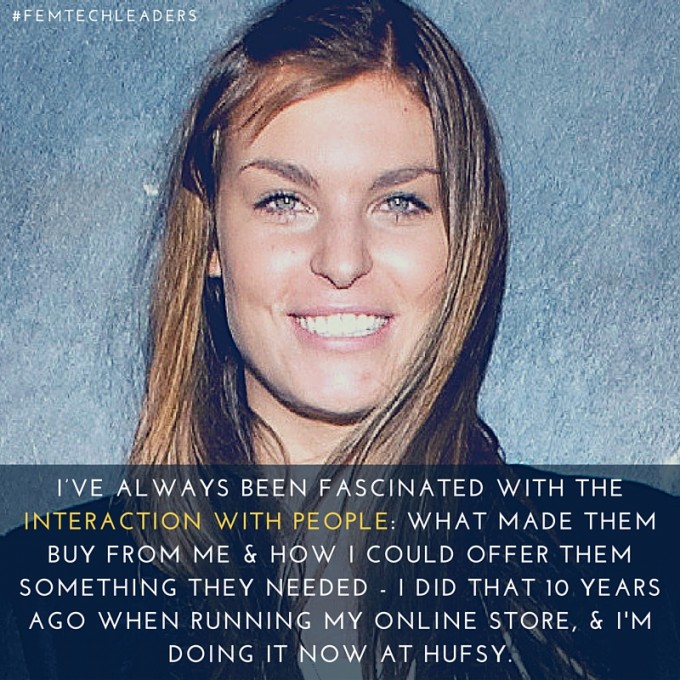
I’ve always been an entrepreneur by heart. As a child I spend my summer holidays at our vacation house down by the road where tourists passed. I sold everything from drawings to cookies and lemonade to thirsty tourists. I’ve always been very fascinated with the interaction with people, what made them buy from me and how I could offer them something they needed.
When we spoke you mentioned you’ve “been doing design thinking for years now without knowing it”. What did you mean by this?
Design thinking is a human-centered approach to solving problems. You always go out and test your hypotheses and assumptions with potential users before you build the solution. The aim is to get a deep understanding of people’s actual needs, making something they really want. When doing this, you constantly go out and validate your ideas, thoughts and assumptions, you learn from that, iterate your ideas, thoughts or what you already build, and then you go back and validate again. It’s an endless cycle of validating, learning and iterating.
Because I was always very observant and interested in the interaction with people, I’ve been observing real problems that I then tried to solve before I even knew that it was an actual method and that it had a name. I think many entrepreneur unconsciously use design thinking and other human-centered approaches when they build a company because they experienced a problem themselves or observed one.
How do you use Design Thinking in Hufsy?
We are working very close with small businesses to make sure that the service we develop is solving a real pain that they have. We interview them, observe them and have them tell stories of situations where they were happy or frustrated with their financial tools. That way we try to understand how our users think, how they behave and what their needs are to provide a service that is not just based on our assumptions of what they need, but a service that truly meets their wants and needs.
We incorporate this understanding into every aspect of our process, and we continuously validate our assumptions and service with our end-user so we can provide a great experience for our users.
You mentioned that you are using the blochcain technology in Hufsy. How are you using it and how do you combine blockchain and design thinking?
We use blockchain for some part of our setup.
An important point for us is that we only use blockchain where it makes sense, i.e. where we have identified blockchain as the best technology for the purpose. Our main focus is always on the needs of small businesses and how we can satisfy those needs, and this is the core of design thinking. Whereas it seems like many banks and fintechs are focusing on blockchain first and then trying to find a need to satisfy with blockchain.
How would you describe the innovation environment in Norway?
I’m a Dane and I moved to Oslo, Norway in August 2015.
Oslo is in many ways Copenhagen’s “little sister”, and I feel that this is also the case when it comes to startups and innovation.
However, since the oil crisis hit Norway I feel that much more people and organizations are looking to found and support startups.
Looking at Scandinavia as a whole, I truly believe we can offer something good to the world. Especially when it comes to fintech. Scandinavia is known for its design and simplicity, I believe we can bring that to the digital world, making simple and intuitive digital financial services by using our scandinavian way of designing.
You noted a new term for me “Jantelov”. What does this word mean and how does it apply to innovation in Norway?
Ha ha. Yes, I mention the word ‘Jantelov’ or in English, the Law of Jante. The word was created by a Danish-Norwegian Author, Aksel Sandemose in 1933 and is from the novel ‘A Fugitive Crosses His Tracks’.
The Law of Jante has been used to describe Scandinavian people and the fundament is basically that you shouldn’t think that great of yourself. It sounds very negative, but it in some way reflects how Scandinavians are; pretty humble and “under-played”. Also, I think Scandinavians are in some way about to break out of the Jante Law by, for example, starting startups, and thereby breaking out of their social groups and going towards reaching a higher position in the society.
On the other hand Scandinavian people is very used to collaborate, meet different people and are often open to new things. This creates a good and informal environment for building up something new.
Why do you believe blockchain technology is such a game changer for the financial services space?
I think blockchain is very hyped at the moment, and I think non-technical people are trying to understand the blockchain technology in a much greater detail than what is actually needed. Of course we need the cryptographers, the PhDs and the software engineers to understand these technical aspects, but for the rest of us, the most important thing to understand is where it makes sense to apply blockchain and the value blockchain provides. As an example, it can be important to understand that blockchain can enable real-time, cheap payments and how to incorporate that into a great user journey. However, it’s not equally important to understand exactly how the payments are technically executed on the blockchain. It’s the same thing with the internet: Most of us have no idea how it works technically, but we still understand how to use it and utilize the benefits of it.
That being said, I think that there are a number of areas for applying blockchain, and I think that blockchain can be a game changer in the financial industry because it enables democratizing of many banking services: It allows the exchange of value peer to peer in real time, all over the world for almost free in a trusted setting.
I think smart contracts can help effectivize the loaning process, selling our house and even claiming insurance.
Blockchain can enable us making payments anywhere in the world faster, at lower costs, reducing errors and cutting out the middlemen. That would be a game-changer for remittances.
Also when using blockchain for digital identity and KYC: Recording digital identities on the blockchain protocol can enable you to have one identity online that works everywhere. You will have your identity on a shared ledger, and then you can add devices to that shared ledger that can pay on your behalf (like your Kindle or your fridge).
What do you believe are the consistent misses when it comes to financial services and design thinking?
One consistent miss or mistake that I’ve observed when working with banks and innovation, is not taking the end-user into account.
Traditionally, banking products have been built by engineers and bankers and they have been built with technology (is this possible to develop?) and the viability (is there a business model here? Can we earn money on this product?) in mind. The human perspective and the desirability of the product is often being left out, which result in products with poor user experience that often do not solve the pains and meet the real wants and needs of the user.
Also, bankers are often very into their own financial products and offerings, and they think they know exactly what their customers want. Hence, they way too often build new digital solutions in isolation without asking potential users along the way. This typically ends out in bad user interfaces that does not meet the needs of the user it was intended to.
You mentioned the influence of both your parents with respect to how you approach innovation and entrepreneurship. What key lessons did they impart to you?
I think there’s two aspects to this:
Firstly, both my parents are academics, working at universities. When I was younger it seemed like the most boring job and I didn’t understand what they actually did - other than reading and writing a ton of articles and books. Therefore, I always had it as a goal to not do what they did professionally when I grew up. Now, I see that the apple doesn’t fall far from the tree and I do have a masters degree and I am very interested in the academic and theoretic side of things. However, without practical inputs and experience I don’t thrive. I think this is also reflected in my years taking my education: Ever since gymnasium (grammar school) I have been doing startups “on the side”. In grammar school it helped me earn some extra bucks running my own online store which I later sold and went travelling for the money. During university, running a startup with my two co-founders who were also studying, helped me apply the theories I learned to real-life situations such as supply/demand, leadership, microfinance, accounting, statistics, etc.
I truly believe that if universities were better at incorporating internships or other hands-on approaches during the years of taking a degree, graduates would be more independant and better equipped to handle the tasks and challenges they meet in their first jobs.
The second aspect is that my parents always helped me with my entrepreneurial endeavours: They were moral support when I was a six year old standing in the heat outside our vacation house selling lemonade to bypassers, they helped me with questions or frustrations I had when my online store started becoming a serious business, and my mother even authorized to be legally liable if anything happened, because I was under age and therefore not legally permitted to own a company at that time. Further, my father has always taught me to be curious, not be afraid to stand out and to not care about the “Jantelov” (Law of Jante) that we were talking about earlier.
Who do you consider to be strong women leaders in the FinTech space?
Blythe Masters is definitely one of the strong women in the fintech space that I look up to. Her career shows that the lines between working for a large established financial institution and a startup is blurring out: You can do both during your career, and, personally, I think it is beneficial to change what you’re doing once in awhile and shake things up.
What do you see as the 3 leading future trends for FinTech?
- Blockchain - As Chris Skinner has said, the technology is currently over-hyped and under-performing, but I think it’s just a matter of time until the hype will fall and the technology will start showing its worth.
- ‘Fintegration’ - especially banks and startups collaborating, but also other kind of industries integrating into Fintech and collaborating with Fintechs. Boundaries will be torn down and I believe that cross-sector collaboration will be much more common in this industry in the future.
- Design Thinking - I think the importance of design thinking are understood by many people in the financial services sector, however, only few actually apply the principles when developing new products and services.

© 2015 | FemTech Leaders
Start the conversation