Ruth Handcock
Chief Customer Officer, Tandem Bank
London, United Kingdom
@RuthHandcock | LinkedIn Profile
You’ve had an interesting career path – from working at a charity in West Africa to now being Chief Customer Officer at Tandem Bank. How did that happen?
My career has been really varied, by virtue of picking jobs that I find interesting as opposed to trying to curate a particularly conventional CV. I figured out that my ideal roles tend to be fast moving and commercial, but with a purpose that goes beyond commercial success. Sometimes that means I find myself in the development sector – in Sierra Leone I was working in the Ministry of Trade to attract foreign direct investment into the country – while other times I’m in purpose-driven private sector organisations like Tandem. I’m also a big believer in finding roles by talking to interesting people you admire rather than through recruitment channels. From my experience it is much more likely you will find someone who will believe in you through a direct or personal connection.
In fact, you keep visiting Sierra Leone regularly. What keeps you going back?
Sierra Leone is a spectacular country and I’ve got lots of friends there. One particular man, Sulaiman Turay, drove for me when I lived in the country. He’s one of the most inspiring and determined people I ever met, having survived a brutal civil war, taught himself to read at the age of 28 and trained as a mechanic so he could support his family. I helped him and a local headmaster re-build a primary school, which now educates about a hundred children, many of whom don’t have families to support them. We set it up as a UK charity (www.swats.co.uk) and I try and get back to help out.
What’s your test for what you choose to do with your life and career?
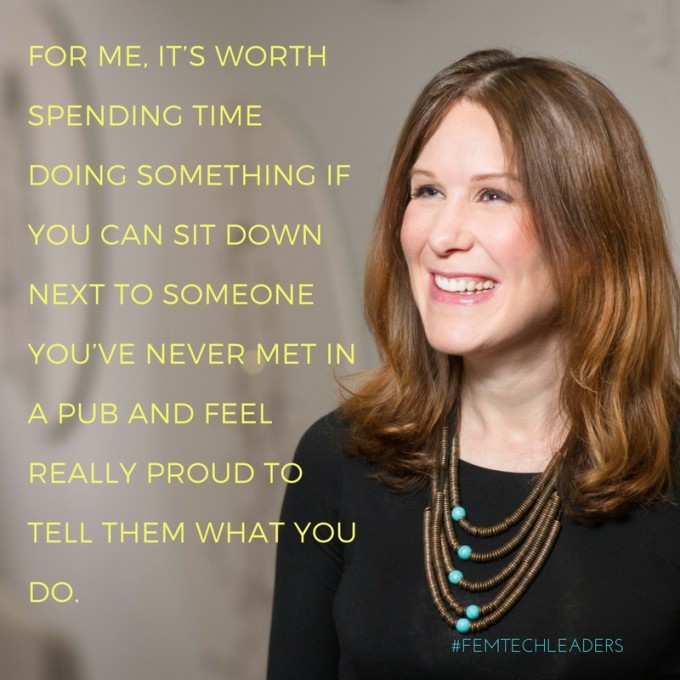
In recent years I’ve developed something I like to call the ‘Pub Test’. For me, it’s worth spending time doing something if you can sit down next to someone you’ve never met in a pub and feel really proud to tell them what you do. It could be anything from making the world a better place, to trailblazing in a new sector, to smashing records for the value you’ve created in an organisation. It’s incredibly personal, but we spend too long in our lives working for it to be about CV status or the money you take home.
You’ve mentioned that your work is “beyond the economics” – what do you mean by that?
Part of what attracts me to purpose-driven organisations is that I find the challenges they present inherently more interesting to solve. At Tandem we’re trying to build a bank that improves customers’ relationships with their money, at the same time as making sure it’s commercially successful. Bluntly, it’s hard to do both and the challenge of that keeps me interested way longer than bottom line targets would alone.
Tandem is one of the few challenger banks that has a license, and you oversaw the process. What did you learn during the licensing application process?
Leading the process of securing a banking license is one of the most fascinating things I’ve ever done, and we’re proud that we are one of only a handful of banks to receive a new retail license in the last 100 years.
Few people get the opportunity to learn, challenge and create every single angle of a retail bank and understand how each element fits together. Retail banking has endless layers of complexity but at its heart is a wonderfully simple idea whereby one person deposits money, and another borrows it. All the bank does is match the two together, and insure the transaction in case one party doesn’t make good on their promise. Modern banks then structure themselves to add safeguards to make sure nothing goes wrong. One of the challenges of the industry is that many people working in it don’t get the opportunity to understand how all these safeguards fit together and why they’re all important, and that’s when things can go wrong. I’m not saying everyone working in banking should draft a banking license application from scratch, but it certainly helps you understand the consequences of every decision.
Your tenure at Tandem has given you responsibility for not only securing the license, but you’ve been part of the technology build, and now you’re focused on the customer. What were your key take-aways from each of those roles?
For me, Chief Customer Officer – my current role – is where everything should start. At Tandem our mission is to get to the core of peoples’ struggles with money - the stress, the indecision, the uncertainty - and fundamentally change their relationship with their finances. My takeaway is just how important it is to talk to our future customers day in day out. We set up a co-founder programme so people can help us build the bank they want.
Managing the build programme – of which a big part is technology – is the building block to enable this customer focus. I learnt here that you need to pick your battles. Tandem is using a utility back end banking solution. To my mind, it’s just not worth re-inventing the core engine that we use to manage customer accounts. Instead we should prioritise investing in the bits that change things for the customer: the digital interface, the contact centre, the design of the propositions.
Did you hesitate to take on the Chief Customer Officer role?
Not for a second: it’s a privilege to be the guardian of the piece of the business that we feel most strongly about. I was also really proud that we’ve built a company where no-one questioned me taking on that challenge when I was five months pregnant with my first child. The arrival of the littlest Tandemer has given me a couple of months to re-group and reflect on the challenges ahead before I dive back in in the Autumn.
As a woman on the executive team at Tandem, what are some of the challenges you’ve seen in creating a culture that embraces diversity in fintech?
As someone who hasn’t spent their entire career in financial services, I’ve been staggered how much more challenging it is to attract brilliant female candidates in banking and therefore create a workforce as diverse as our customers. Applying to work at a challenger bank requires a higher risk appetite and roles are generally broader than at our more traditional competitors. I worry that female applicants are more likely to rule themselves out at application stage – thinking they won’t succeed because they don’t have experience in every aspect of the job specification - even though they are as able to deliver as their male peers. I don’t personally believe quotas are the answer, it’s about getting the right long term incentives: hiring managers who believe a diverse workforce will give better results, and an application process that attracts and encourages the people we want.
What are you doing differently to evolve that culture at Tandem?
Creating a culture from scratch is enormously exciting. We’re a purpose-driven company so values are key and I’m really proud of how often I hear colleagues question each other on whether a particular decision is really the right thing for the customer. As well as that I love the little touches: free Friday lunches with a speech on anything from a member of the team, team yoga, and peer-nominated Tandem heroes. One of our newer ideas is Tandem Acts of Kindness where each week we draw names from a hat and a few team members need to do something that brings a smile to the face of their colleagues. It definitely increases the amount of sugar consumed, but some people get really creative, like our resident former-professional chef (now Operational Risk Manager) cooking colleagues a gourmet meal.
Who has had the most influence with respect to your own career? Why?
I’d start by saying that I feel lucky to have worked with some phenomenal people, but I think female role models are still a little thin on the ground in banking. I’ve found – particularly when I was pregnant – that more and more women early in their careers have sought advice on whether it’s possible to smash the glass ceiling and say they have no-one else to ask. There’s a lot of work to be done on creating inspiring female role models.
For me, career influencers have come from all over the place. My first taste of entrepreneurialism was working for Caroline Plumb and Charlie Osmond, who founded FreshMinds. They were the first people to give me my own P&L and let me just get on with it, and I got a taste of what growing a £1m revenue business unit from scratch felt like.
At the Africa Governance Initiative I was lucky enough to work for both Kate Gross and Tony Blair. Kate was not only one of the youngest Civil Servants ever to support a Prime Minister, she also set up AGI from scratch. Kate showed tremendous strength as she fought cancer while writing her first book – Late Fragments – and the world is a much poorer place without her in it. Tony Blair on the other hand has his detractors in the UK, but in Africa he taught us how to have an impact in fledgling governments far beyond the conventional wisdom through a combination of hard work, inspiration and bold ideas.
Finally, I’m tremendously lucky to have a husband who believes in me. There is no way I’d have the career I have without his encouragement. I also think that you’re much more likely to be able to juggle family and career if your husband has an equal attitude to what a marriage and family should look and feel like. There’s no ‘main breadwinner’ in our house. Instead we both do what we can to find the balance that works at that point in time.
Who do you consider to be strong women leaders in the FinTech space?
Much as I would love to be able to point to a cohort of industry role models who have really influenced me, the reality is that I’ve taken a lot of my inspiration so far from outside Fintech. I am routinely inspired by women I know who are brave and successful entrepreneurs in mission-driven businesses. Kresse Wesling has been running Elvis and Kresse since 2005 and has created an aspirational brand from reclaimed materials (mainly fire hoses!) and donates 50% of profits to charity. Similarly, in creating The Fold, Polly McMaster has figured out that professional women need stylish but appropriate clothes to wear at work and creates these at the same time as building and championing a social community of inspiring women. Watching people like Kresse and Polly build their businesses and succeed is a real motivation for me. It would also be remiss of me not to mention my fantastic female colleagues at Tandem who do a stellar job across many functions and bring so much to our team.
What do you see as the 3 leading future trends for FinTech?
- I’ve been interested to see how many of the FinTechs I like the look of recently have used Wirecard systems to power them. It feels as if the open API concept is finally having an impact and allowing great businesses to get off the ground quickly. It’s good for innovation and this ecosystem approach is certainly something that Tandem will be a part of.
- Solving the customer problem, rather than showing how clever you can be. To some extent I get the Henry Ford adage that ‘if I had asked my customers what they wanted I would have made them a faster horse’ but I do think FinTech sometimes solves problems that customer don’t care about just because it can think of a new way of engineering the tech. I think there are more and more examples of actually tackling the challenges that customers care about: taking the cost out of cross-border remittance, decent invoice finance, free credit scores, and I hope this will continue.
- Mobile first. An obvious one, but I think we’ve hit the tipping point – even in the more traditional banking sector – of mobile being more important than web. It’s great for the customer since it’s much easier to build a relationship via the mobile phone than a web portal and you can develop a much richer experience.

© 2015 | FemTech Leaders
Start the conversation