Reetika Grewal
Head of Payments Strategy and Solutions at Silicon Valley Bank
San Francisco, California
@rgcinco | LinkedIn Profile
I always love interviewing first generation citizens as their parents typically are such strong advocates for professional studies/careers for their children. Does this generalization apply to you?
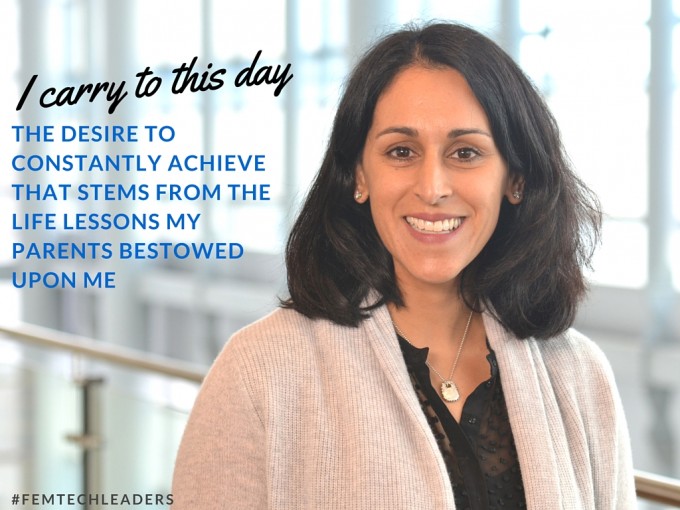
Very much so. My parents took a lot of risks in order to ensure that my sisters and I had access to a high quality education and personal growth opportunities. My older sister and I were both born in England; we then moved to Canada where my younger sister was born. When I was in the second grade we moved across the border to Michigan for the stronger school system. Growing up, I was highly aware that my parents made significant sacrifices for us and this meant that we didn’t take anything for granted. My Dad championed hard work and “achieving to your potential” (that was his key phrase growing up). He passed on to my sisters and I a strong sense of work ethic and it stuck pretty hard - both of my sisters also have successful careers in their respective fields. My Mom also worked, which was a little less common back then. In hindsight, my mother’s career really helped to reinforce the criticality of workplace gender equality. My Dad always told us to stand up for ourselves, and to not let anyone tell you that you couldn’t do something because you’re a women, and that you need to be financially self-sufficient. When it came to college, our choices were limited to the state schools as they were within our budget. I attended the University of Michigan, which is a fantastic school, and I feel very fortunate that I was able to attend. I carried with me through college, and still carry to this day, the desire to constantly achieve that stems from my parents sacrifices and the life lessons they bestowed upon me to set me up for success as a first generation citizen.
How did working in a chocolate factory prepare you for driving innovation in Financial Services?
It does sound like a giant leap from chocolate to financial services, but there are a lot of similarities between the work that I did there and throughout the journey I’ve made my career. I worked at a high-end chocolate company that manufactured chocolate, maintained a retail presence and a thriving corporate sales business. It was a complex operation that put me in the middle of learning what it takes to run a business from the ground up. We worked with clients like Starbucks, Williams Sonoma and Barneys, and created customized products that could be manufactured at scale. Understanding operations, cost accounting, managing people, making tough business decisions, as well as being really creative and offering great service were all very much a part of the day-to-day work. The product and production methods were obviously very different from financial services, but what has been consistent across my career is the practice of product development and developing a deep understanding of the client in order to design products and services. The owner of the company, Gayle, was a great mentor to me and I learned a lot from her about tenacity, selling to corporates and large multinationals, and really loving what you do (how can you not love chocolate!).
You spent a period as a consultant, as have many interviewed for this series. Why do you believe this is the case and how did this benefit you in your future roles?
Working as a consultant places you in the role of getting up to speed quickly on a business, critically evaluating the business, and bringing your problem solving expertise to help the company overcome challenges and take advantage of opportunities. These abilities and experiences are highly valued skills for anyone operating in complex roles or industries. As a consultant, you very quickly gain exposure to a wide variety of topics. This can allow you to develop a strong perspective for the things that you are most interested in, so that when you do come across your next opportunity, you can tackle it aggressively and apply yourself immediately.
You focused on User Centered Design at Sapient. Are you a fan of this process?
I am a huge fan of this process. Through ethnographic research you can ask the user what they think, but more importantly you look at what they do and the tools they use to fully understand how they interact with the subject. One of my projects when I was at Sapient was to help redesign a car. We studied customers across various car types to understand what goes into the car selection process as well as the ongoing enjoyment of a car. We drove around with people in their cars for weeks, went to their homes, and interviewed them about their experiences and their self-perceptions related to their car. We were able to provide a great framework to our client to use to design their new series. I remember seeing the redesigned car once it was released to market and could point to specific things that came from that research. Making sure you really understand clients and what will change their behavior or improve their experience is the key to any successful product development process and financial services are not any different. Thinking about some of the great new fintech products that are out there, you can see where companies have a deep understanding of customers and that has strongly benefited these companies in their design and development.
“I fell into banking.” What did you mean by this statement?
When I was in business school I really fell in love with strategy work and I knew I liked technology and complex businesses. It wasn’t until I met with a few different people through career services at school that I found the intersection of financial services and technology as an ideal place to start my career…so I kind of stumbled into banking.
“I love payments because it is so complex.” You used this phrase to describe your time at Wells Fargo. Can you elaborate?
When I joined Wells Fargo, I was in a rotational program that had me move around various groups within the Online Banking team. I had a rotation on the payments team and after that I was sold on payments. I liked thinking through the impact on customers, the way that every time you moved money it touched so many different systems, the reliability of the systems was really important, and the regulations that governed every transaction.
I love learning and there is an endless list of things to learn when it comes to payments. I am still learning; changes in regulation, technology, customer expectations; it provides a constant source of learning which keeps me really engaged and motivated.
What makes Silicon Valley Bank unique in your opinion, especially in reference to FinTech and innovation?
We are exclusively focused on the innovation sector and have been for more than 30 years. Our specialty is working with innovative clients of all kinds, including entrepreneurs, VC-backed startups, mature technology and life science companies, venture capitalists, VC firms, and private equity firms. Because we specialize in working with companies at their earliest stages and support them as they grow into mature, large companies, we understand their businesses, can be flexible, and tailor solutions to their needs. This is an important point of differentiation from most banks and makes SVB unique. The knowledge, experience, and connections in the innovation space that we’ve developed, specifically within in Fintech, and the pace we deliver our services, makes a meaningful difference in our ability to increase our clients’ probability of success. My team specifically works in the payments, fintech and commerce space from a payments/money movement perspective and we partner closely with the lending teams that specialize in this area. We have been able to work with great companies that are disrupting the space and leveraging our infrastructure to power their businesses. It is a pretty unique model.
You are in a high profile role and have been recognized as a leader in the payment space. How do you decompress for your role?
I have to admit that I am not great at decompressing. I do have an amazing, supportive husband and two awesome kids, and we definitely enjoy our time together. We live in Marin County and spend most of our weekends outside on a trail biking or hiking. It is a great way to recharge as well as spend time together as a family. I also live close to my two sisters and we support each other and help each other recharge as well. I feel very lucky to be within 30 minutes of both of them.
Who(m) do you believe has had the most influence with respect to your own career?
On a personal level, my husband has the most influence with his unfaltering support of my career. Even though he has a really demanding job as well (he is a physician), he is the consummate supporter and encourages me to take risks and push myself. He understands what drives me and helps me think through opportunities and challenges. He has an outsider’s perspective, which is also helpful, but I do have to keep in mind that doctors are generally terrible business people since they focus on delivering care. On a professional level, I have had a few people provide guidance to me throughout my career path including great bosses at other companies as well as a friend of the family that has provided key insights. I have a great boss at SVB as well, Bruce Wallace. He is really creative, ambitious, and you can tell that he really loves what he does. That is inspiring and drives me to be the same way.
Who do you consider to be strong women leaders in the FinTech space?
There are a lot of strong, great women leaders in FinTech. I have a ton of respect for Pamela Joseph. She is an amazing leader with a great track record of building strong businesses. I also have gotten to know Christine Larsen, COO of First Data. She is a great leader, as well as a champion for women in business and a great mentor to many.
What do you see as the 3 leading future trends for FinTech?
I see the future being driven less by a handful of leading trends and more by a set of common emerging themes. Generally speaking, it is hard to ignore the great level of change that has been stirring in the Fintech industry. This transformation has, and continues to be, driven by the tremendous advancements in digital technologies that are permeating nearly all aspects of life- from the way we live and communicate to the way we shop and pay for things. The industry is being flooded with new ideas and players creating new technology solutions that might forever change the financial services landscape. The new models share themes including removing friction from legacy processes, providing 24/7 access without logistical limitations, near real-time decisions, and, most importantly, a new level of transparency for customers. This is fundamentally changing customers’ expectations of payments and financial services.

© 2015 | FemTech Leaders
Start the conversation