Maria Dubovitskaya (PhD)
Research Staff Member at IBM Research - Switzerland
Zürich, Switzerland
@m_dubovitskaya | LinkedIn Profile
Can you please provide an overview of your role at IBM Research?
I am a cryptographer in the Cognitive Computing and Industry Solutions department at IBM’s two time Nobel Prize lab in Zurich, Switzerland. My responsibilities include designing cryptographic protocols for privacy protection and applying them in practice. I have been granted three patents with several more pending in the security field.
When I’m not in front of my keyboard or whiteboard, I am involved in volunteer programs like IBM E.X.C.I.T.E (Exploring Interest in Technology and Engineering), which is aimed attracting middle school girls into the field of science, technology, engineering and math.
What attracted you as a young student to cryptography?
Since I was a child I loved puzzles and mathematics, and cryptography is really a synthesis of both. It is a very exciting application of math that solves many real-world problems. In fact, secure electronic transactions would have been impossible without crypto.
You stated during our discussion that cryptography is the intersection between math and computer science. Can you expand on what you meant by this?
First, we design cryptographic protocols and prove them to be secure using math. Then we translate them into a computer program using computer science. It is crucial to implement such software properly to preserve the security properties of the protocol in a real-world deployment.
Do you believe the term “privacy” is undergoing a fundamental shift in definition?
Some people say that only “bad guys” who have something to hide need privacy. But this is not true. Everyone has the right for privacy - the right to keep personal matters and relationships secret.
The question is if we have the possibility to use different services and still keep our personal information private. Nowadays we are sharing more personal data on the Internet than ever before. That is why our identity is worth less than $1 dollar on the black market today, compared with $150 10 years ago.
Many people believe privacy is dead, but my colleagues and I feel differently. With IBM Identity Mixer we give choice and control back to users to decide what data is shared and with whom. Then we can start to value our personal data properly.
How do you believe companies such as IBM are positioning themselves concerning consumers and data privacy? What role do these companies play in the digital payment and identity ecosystem?
There is a very good blog post from Christina Peters, IBM’s Chief Privacy Officer which explains IBM’s position nicely. Essentially it comes down to “privacy by design” and “transparency”.
We provide the technology that can be easily used by the service providers end by the end-users to enable privacy-preserving authentication.
The underlying cryptographic protocols were verified by the scientific community and most of our code is open-sourced and therefore anybody can verify and use it.
I would call IBM in this context a technology enabler.
You competed at the highest level in Russia in competitive aerobics. What did you learn about yourself and your approach to learning from this experience?
First, I have learned some fundamental truths that one learns while doing any team sport: team work, responsibility, persistence, hours of training and hard work are the key to success. All of those easily project to our everyday work and life.
Second, I think that performing on stage during competitions helped me a lot in public speaking. Aerobics performance is evaluated by the two criteria: technical elements (content) and the artistic part (delivery). You have to get over your fear and brace yourself to perform at your very best. When the technical part is brought to perfection, you enjoy the moment and release your positive energy. Same holds for public speaking - when you are on stage you should not worry about the content anymore and engage the audience.
You’ve given several talks on cryptography including a TED@IBM talk. How do your ensure you are able to present complex topics to the widest audience?
When I first spoke to my colleagues about speaking at TED I thought my chances were 1 in a million. I must admit it was an incredible experience and before doing it myself I could not imagine how much work is put into it - weeks of working on the text and practicing. But it’s definitely worth the effort - to have the opportunity to reach such a wide audience and talk about our privacy technology.
It is indeed quite hard to explain complicated research topics to any audience. The main tips here are to give simple examples, use mostly graphics, and add a couple of jokes.
Usually I feel a bit nervous during the first seconds of my talk, but then I feel relaxed and enjoy it a lot.
You’ve received the Anita Borg Change Agent Award and are also very active in introducing STEM concepts to younger women. Why is this important to you?
I would like to give girls more information about technical career paths and possibilities so that they could choose a career without being influenced by the stereotypes.
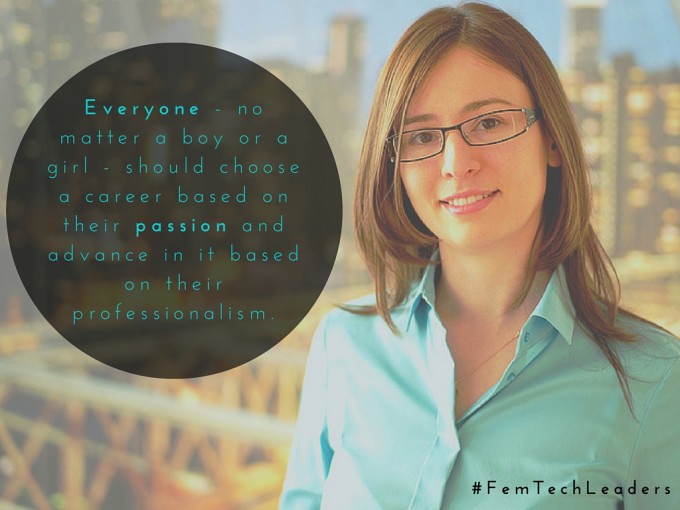
Everyone - no matter a boy or a girl - should choose a career based on her/his passion and advance in it based on his/her professionalism.
We just need a bit more female role models out there, but we should not stress the problem of “how to survive and make a career as a women in tech”.
What has the experience like leaving your home in Russia to work in Switzerland? How different do you find the work environment to be?
Speaking about women in technology, I have the impression that in Russia more women pursue technical careers.
I can hardly name the differences, but I think in Russia the work process is more deadline-driven, while in Switzerland there is much more planning involved and the work process is more smooth. In Switzerland I also see a very strict separation between work and personal time.
You had the opportunity to be interviewed and participate in a photo shoot for Russia’s Glamour magazine. How was this experience? Just like being in the computer lab I would imagine.
My path to appear on the page of the Glamour magazine was certainly not the one that any girl - including myself - would imagine. That was one of the reasons why I did it. I thought I could reach a new female audience and introduce them to computer science as a career path. It was a completely new experience - a lot of fun, but not as easy as one might think. I must say that now I have a lot of appreciation for Heidi Klum.
Who(m) do you believe has had the most influence with respect to your own career?
First, my parents who supported me in everything and cultivated curiosity and dedication to self development and growth. When I was a kid, my father bought me a programming book for kids called The Encyclopedia of Professor Fortran, and also brought home a very simple computer. Since then I was hooked.
Later, my mentors and advisors Elena Minaeva, Philippe Janson, and Jan Camensich helped me a lot in my career. I think that mentorship is very influential for the career development and also very rewarding for the mentors themselves. I would recommend everyone to engage in a mentorship program as a mentee or a mentor.
What do you see as the 3 leading future trends for FinTech?
As a cryptographer, clearly security and privacy technology. I was recently reading a report that Sweden may become the world’s first cashless society — incredibly some banks no longer accept cash. While this is convenient, the flip side is that your card transactions could fall into the wrong hands. This is exactly why we are developing our Identity Mixer technology, to add anonymity between the data and the transaction.
The next trend making waves is blockchain, which I think of as an operating system for interactions. Blockchain got its start several years ago as a key ingredient of Bitcoin, the crypto currency, but it turns out, the technology can make a difference whenever valuable assets are transferred from one party to another. Banks, financial marketplaces and insurance companies are pioneers in exploring the possibilities, but the potential uses range much wider including supply chains.
The last trend, cognitive computing a la IBM Watson. For example, what if financial advisors had access to everything they need to know about a customer’s portfolio, with a click of a button – informed by an instant, 360 degree view of what’s right and what needs to be fixed, to usher that customer into the retirement they deserve? That’s what Watson is doing for ANZ Bank and I think it is the future.

© 2015 | FemTech Leaders
Start the conversation