Maxine Ryan
Co-Founder and COO at Bitspark Limited
Hong Kong
@MaxieRyan | LinkedIn Profile
Bitspark is the world’s first cash in, cash out blockchain remittance solution for businesses. We provide backend software for MSB’s to send their customers funds overseas faster and cheaper without any tech knowledge necessary.
We’re unique in the Fintech space as our focus is on providing a blockchain solution on the backbone of the cash remittance industry, the MSB’s. We are ‘Swift for the unbanked’ where our company mission is to help those in need by disrupting the remittance industry with blockchain tech.
What stands out the most during your experience as a start-up co-founder?
Being a co-founder at the beginning of a fintech company means having various roles which range from every aspect of the business. For me, it’s all about strategising and executing the company’s vision for long and short term objectives while being adaptable.
What was your school experience like and how has this impacted your career approach and decisions?
Schooling was never productive for me as it punished for failure and I failed a lot. I didn’t have good grades, was a misfit of sorts and always found myself uninspired. This taught me that convention was mediocre and that constantly trying new things with a passion and failing was a better type of education. It’s taught me to just go for it, try new things and take opportunities even if you feel uncomfortable. If you feel out of depth, you probably are but take it as an opportunity to become an expert in the unknown. I like to think of my start up experience as an unconventional MBA where education is only limited by mind-set and agility towards opportunities.
You used the term “dictate my own future” to describe your decision to co-found a company. Can you elaborate?
I quit a promising degree six months before graduation because what I saw for my future was meek. It’s well known that diversity in every industry is a problem and if I followed the corporate path I had to rely on others to progress. Statistically, this wasn’t a sound option for me as a career approach and starting a business meant I could position myself in an unlimited capacity and dictate to the best of my ability my own fate.
Bitspark is used heavily by the domestic help market in Hong Kong. Why is this?
We are used heavily by the domestic helper market as MSB’s using Bitspark’s backend software for remittances provide more competitive rates and prices in a landscape which is monopolised by bigger remittance firms that have created a pricing stalemate. Essentially we enable remittance businesses to send their C2C funds with larger margins which in turn relays cheaper and better remittances to MSB’s customers who are prominently domestic helpers residing in Hong Kong. For migrants which earn 500-600 USD a month, Bitspark is able to provide a cheaper service which saves them money. Besides the obvious gains for businesses and individuals, I think we owe our success to reverse engineering the entire process from when the cash leaves the senders hands, though to the businesses, the middle men and to the recipient and found the direct pain points consumers feel in all aspects. Bitspark is built on consumer facts and fixes what directly needs to be improved rather than building upon assumptions of the market place.
What is has been your experience as a young female founder in the Hong Kong FI space been like?
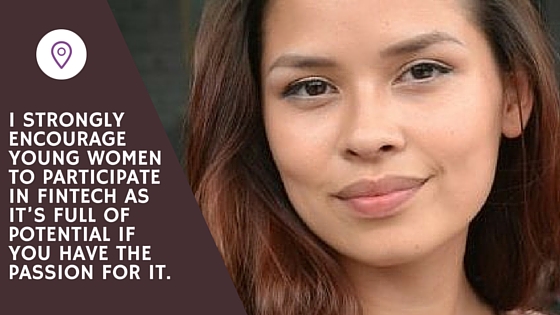
It’s lonely and is trying at times but I would say this environment is evolving for women. Diversity in the Hong Kong financial services space is changing and is being advanced as an objective of the industry; however, it’s not always an easy space to operate in due to misconceptions of the roles women are typically stereotyped with (e.g. if I had a penny for every time I was misconceived as “the marketing girl” instead of co-founder or COO, or the amount of times I’ve been greeted as Mr. Ryan or Mr. Max in emails I’d be rich!). Unprofessionalism does exist at times, though I make a point turn it into an educational opportunity and redefine the standards of the industry as in most cases it’s simply unknown etiquette. In saying this, I strongly encourage young women to participate, especially in fintech, as it’s full of potential if you have the passion for it.
There was an article in Fusion this past summer (http://fusion.net/story/124655/why-bitcoins-male-domination-will-be-its-downfall/ ) that detailed the lack of women in the BitCoin space. Do you agree with the author?
There is a lack of women in this industry but while there is a deficit, women in this space are in significant and substantial roles ranging from hardware, software and management which couldn’t be said about other S.T.E.M start up industries as new as cryptocurrency / blockchain. I disagree with the Felix as the success of cryptocurrencies/Blockchains future isn’t reliant on which gender is the driving force behind the technology, however does diversity bring a more equal representation of solutions to world problems? Absolutely. The diversity spectrum in technology is being advocated more aggressively now than ever and in the future I’m positive an equal representation of gender will be portrayed though there is still a long way to go.
Who(m) do you believe has had the most influence with respect to your own career?
Venturing into a career in cryptocurrency and fintech was on my own accord as it was hard to find influence from people who I could relate to (i.e. young, female and into crypto and blockchain). I’d like to think that in the future a diverse option of influencers whom a wider range of people can relate to will be available for those who found themselves my position. FI’s are spearheading diversity initiatives and this I hope will encourage women in the future to join the wonderful world of fintech!
Who do you consider to be strong women leaders in the FinTech space?
- Blythe Masters- Digital Asset Holdings
- Melanie Shapiro- Case Wallet
What do you see as the 3 leading future trends for FinTech?
- Payments/remittances
- Regulation technology
- Lending

© 2015 | FemTech Leaders
Start the conversation