Jackie Hyland
Investment Associate at Accion’s Venture Lab
Washington D.C.
@jackie_hyland | LinkedIn Profile
Can you please provide an overview of Accion and your role at Venture Lab?
Accion is a non-profit organization that’s invested in and supported microfinance institutions for over 40 years. In 2008 and 2012, Accion expanded its investment activity and created two new globally opportunistic investment initiatives that would invest in early stage companies “beyond microfinance” and within a general financial inclusion thesis. Venture Lab was one of these initiatives and began in 2012. I joined the team mid-2014 and currently lead our investment work in Latin America – my portfolio now consists of six early stage fintech companies across the LatAm region. Part of my role is to source and diligence new investments, as well as support and engage with our current portfolio. Because we are the only early stage financial inclusion fund (at the moment) a big part of my role has also been to engage with the industry and share our learnings, challenges, and successes.
You’ve excelled in your academic career (Fellowship Award at MIT, Fulbright grant, and you studied abroad in Madrid). How has this experience transferred over to your professional career?
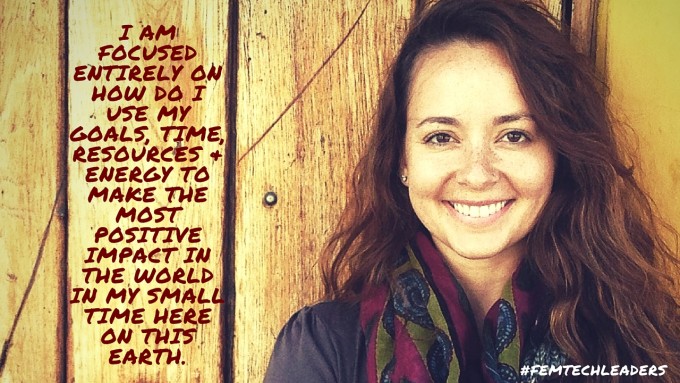
I would say it’s not as much as a “transfer” to my professional career, as it’s simply part of who I am as a person. I’m very goal, achievement oriented and am very much a go-getter. These experiences have shown me that anything is possible with dedication and perseverance. With my career, it’s now less about winning the awards or making the grades, those all set me up to get where I am now, but now I am focused entirely on how to do I use my goals, time, resources and energy to make the most positive impact in the world in my small time here on this Earth.
What led to your interest to a career in FinTech?
I’ve always been very interested in technology from an early age – I was obsessed with computers in junior high/high school (late 90s/early 2000s), and tried coding but realized I loved travel more. So, I began my career mainly focused on becoming a global citizen, understanding complex global systems, issues, challenges, and how we could solve them. During my time in Panama, I began to see that entrepreneurship and investing was, what I believe, the best way to harness and scale change. From there I decided I needed investing experience so did the Fulbright at Angel Ventures Mexico, then worked at a Private Equity Real Estate Fund at Compass Group. In the spirit of impact, I realized that fintech had incredible potential to deeply change the financial systems in which we live that currently excludes over 2 billion people, and wanted to move back to early stage investing from PE, so when looking for opportunities, was naturally introduced to Accion.
You’ve had quite a bit of experience concerning FinTech and Latin America. What makes this region unique when it comes to FinTech products?
Latin America has some of the most developed microfinance industries in the world, so serving those excluded from the base of the pyramid (lowest income groups) is not entirely foreign. There are also huge waves of entrepreneurship in Mexico, Argentina, Brazil, and now Colombia that incentivize and promote early stage venturing. Latin America is one of our most active regions in terms of pipeline – there’s a real inspiration in the region to begin companies and build a better future.
What are the typical assumptions concerning Latin American consumers that most FinTech companies get wrong?
All of them are online. Yes, there is HUGE mobile penetration, social media usage, and growing connectivity, but many of these customers and consumers still need some kind of offline touch point. I’ve seen repeatedly that successful online customer acquisition approaches need to be coupled with offline strategies or partnerships.
What do you see as the key growth areas for Latin America FinTech solutions ?
Latin America has notoriously expensive banking products and services – there’s huge room to build better, faster, cheaper loans, bank accounts, savings products for everyone at any socioeconomic level. I’d say a focus on data - continued use of data to make better products and improve the client experience. So many people feel like banks treat them like crap and/or they are always getting ripped off. I believe that technology and data can really bring ideas/solutions that are more inclusive, friendly, and actually try to help their clients.
You received the 2012 Social Entrepreneur Fellowship Award at the 99u Behance NYC Conference. What work was this focused on? Why is social impact so important to you?
At the core of my intellectual hunger and personal passion is the conviction that market-based solutions are the most powerful way to create social impact and solve the world’s biggest problems. I began my career with the idea that a purely non-profit, social motivation was the key to creating change. But, after working for a variety of non-profits and for-profits, I began to see the emergence of a new economy: a generation of companies and young individuals who didn’t accept that good and bad had to be as black and white as for-profit versus non-profit. The camps weren’t enemies, but alliances, where incentives could be aligned, initiatives could be sustainably built, and a new emergence of business could be born. Working in this new business is now core part of my beliefs about the world and my role here.
You were a standout at lacrosse while you attended Baylor University (3 time MVP). How did you become interested in this sport and what lessons did you learn that apply to your approach to business?
It’s funny, I actually never intended to play lacrosse. I’m a runner. I’ve always been a long distance runner and one track season I got stress fractures in both legs so I couldn’t run competitively and was looking for a way to “relax.” Lacrosse became that sport replacement for me. I ended up loving the team aspect of the game, and that I played with a bunch of other bad-ass, VERY competitive women. They felt like kindred souls. I was part of a team that was Texas state champions three years in a row. Then when I went to college, it was a no-brainer that I wanted to keep playing. Being a runner, everything depended on you. If you won, it was all your glory. If you lost, it was all your fault. Lacrosse helped me rely on others more, understand that success is a team effort, and most importantly that I can’t do everything on my own (even though I still try to believe I can…).
Who(m) do you believe has had the most influence with respect to your own career?
Roberto Charvel, my previous boss at the real estate fund. He was (and is) such an incredible leader in VC/PE in Mexico, and pushed me, inspired me, and encouraged me to do much more than I even though possible in a big time of transition in my career. Even now. It’s amazing how one person who believes in you more than you do yourself, can push you to be more than you thought possible.
Who do you consider to be strong women leaders in the FinTech space?
My colleague Tahira Dosani (our Director of Portfolio Engagement) is definitely a huge example of a woman in the fintech space who has advised and supported dozens of companies in this space – she’s also probably one of the smartest people I know.
I also really do admire all of the female fintech CEOs – takes a LOT of chutzpah to start a company, raise capital, and break into this male-dominated space.
What do you see as the 3 leading future trends for FinTech?
Expansion of uses cases for blockchain for emerging markets/financial inclusion, biometric authentication integration for all fintech sectors, and banks and fintechs realizing it’s not about who replaces who, but how can we work more together.

© 2015 | FemTech Leaders
Start the conversation