Neira Jones
Consultant, Speaker, Board Member, NED | Payments | Digital Innovation | Cybercrime | Security | Fraud
London, England
@neirajones | LinkedIn Profile
You encompass the term ‘personal branding’. What makes you unique with respect to your participation in the FinTech ecosystem?
I don’t think I’m unique at all! Perhaps I stand out more than some – and certainly less than others – due to the fact that I like engaging publically and I’m not averse to a good debate or to challenging the status quo. I also like to speak my mind and, being an independent consultant, I am not bound by any kind of corporate governance or party line. I think this is where my clients find value. I also like exploring new things – from technology to business or science – and evaluating their applicability to my world. I am, in fact, a permanent student and I like learning from the environment I work in and from people that are successful in what they do.
How would you describe the different areas you focus on from a consulting standpoint?
In my former career, I directed global change programmes, launched new products/services and managed process reengineering practices. This makes me ideally positioned to advise retailers, financial services institutions, start-ups, associations or not-for-profit organisations, consulting organisations or technology vendors – especially if they are trying to navigate the 21st century digital maze. I place particular emphasis on ensuring that the benefits of effective risk management attract board-level focus and become a vision enabler. Examples of how I work with clients include:
- Breaking into new geographies,
- Developing digital/mobile strategies
- Getting strategic buy-in at the board level for new payments strategies, cybercrime or information security related investment,
- Developing roadmaps to address shortcomings in compliance with industry and regulatory standards
- Creating a social media approach in line with risk appetite
- Leading targeted product selections and evaluations
- Developing user awareness programmes
If organisations are contemplating change and want to make it an exciting, fun and successful exercise, I can definitely help.
Please describe your ‘journey’ from banking to Information Security. I loved the story of the ‘pink dress and Hall of Fame’.
That was a complete accident. Following my Masters degree In Computing Applied to Business Management, I naturally (because my Mum approved) joined a bank as an analyst programmer, full of theory and bright ideas and the belief that I could change things for the better very easily. Of course (I can hear you snigger) it turned out that the real world is very different from the academic one and I was slammed back to earth by that great terminator of student dreams: operational constraints and its evil twin, budgets. Great learning early on and I had great fun, but I still wanted to make things better.
So, having had first-hand experience with the challenges of being a customer of many technology suppliers, I decided to go and join one (Unisys) where I became a technical sales support specialist for mainframes and wide area networks. Yes, I thought Personal Computers were for sissies at the time, and, after all, the IBM PC was just a decorative item in the early 80s. That was pretty much the theme of my early career, where I alternatively spent a few years with suppliers (Oracle) – always focusing on the Finserv vertical – and then with financial services institutions, primarily in retail banking.
Then it dawned on me in the mid-2000s that there was so much more to financial services than retail banking, and that payments was an obscurely fascinating area. Because work/life balance is as important to me as interesting work, I decided that I wanted to work for Barclaycard (great brand, innovative, and not far from home). I approached them directly (via LinkedIn) regarding any change management job they might have underway. They didn’t at the time, but kindly offered to keep my CV on file. A month later they contact me with a job description carrying the message “it might not be what you’re looking for, but see what you think.” The job title was “PCI DSS Programme Director.” I had to look it up. Payment Card Industry Data Security Standard (gasp!). I knew nothing about the payments industry, and even less about security. But Richard Branson famously said “If someone offers you an amazing opportunity and you’re not sure you can do it, say yes – then learn to do it later.”
So I went for the interview and got the job, built a fantastic team, had an amazing few years and learned to love PCI DSS (amazingly) and information security in general. In my second year at Barclaycard, after making a lot of noise on the importance of payments security and PCI DSS, Infosecurity Europe nominated me to their Hall of Fame. Wow! To be recognised by my peers in such a way was very humbling and I was deeply honoured. I was invited to the induction ceremony and selected the appropriate attire for such an occasion, which in my case means an elegantly tailored pink dress with matching pink stilettos (I probably also had matching pink nail polish). The venue might have been Earls Court or Olympia and after making my way through the maze of stands, I finally arrived at the huge conference room. The organisers asked me to wait for my two fellow inductees, Rik Ferguson and Graham Cluley. Now, these two are serious cyber security rock stars whom I had followed online for a long time and now, not only do I get to meet them, but I get to share the stage with them – yay! And whilst I was pondering my incredible luck, two tall men walked towards me – both wearing black T-shirts, black jeans, black boots and one of them with arms covered in tattoos. When they introduced themselves, all feelings of inadequacy (I should have worn black leather) evaporated. We’ve been friends ever since and I have made many more fantastic friends in the cyber security space over the last few years. So mine is not so much a journey from banking to information security but more a merger of the two worlds – with a good sprinkling of digital innovation. I’m still learning.
You stated you ‘made a lot of noise’ concerning PCI Compliance and this is how you were recognized. How important is it for individuals, and women in particular, to ensure their unique voice is heard?
One of my fantastic mentors once said to me “no one can blow your own trumpet as well as you can.” I say this to all the people I mentor. Just because one does an excellent job doesn’t necessarily mean it’ll get noticed – and this applies to both genders. Having said that, I have found that women are generally more reflective and somewhat less willing to promote themselves (this is only my personal experience). Luckily, due to technology advancements, it is so much easier now to promote an individual brand – and most of it is free for those who make the effort. I cannot stress enough the importance of having a great LinkedIn profile. And you can now also use it to write opinion pieces, so no need to set up a personal blog on blogger or WordPress for those who are just starting. timeliness, relevance, accuracy, consistency and knowledge (TRACK) are key to building an engaged digital network. Everyone gets swamped with too much information and natural selection dictates that anything without those five attributes will get ignored. Of course it has to be fun, otherwise it becomes a chore. So those who want to embark on this journey should only write/ comment/ opine on what they love.
Information security is, generally speaking, a male dominated space. How do you ensure your point of view and voice is heard and taken into consideration?
Information security and payments are largely male-dominated industries on the outside. I know quite a few fantastic ladies in both industries that are public figures, but certainly many more that remain in the shadows. Perversely, it is often much easier to build a personal brand outside of an organisation (your external brand) than it is inside an organisation (your internal network). The former will definitely influence the latter in my experience. As to how to achieve it, it goes back to TRACK:
- Timeliness: making sure that what is shared is up-to-date. People will get bored with old news (unless recalling an old item is relevant to current issues).
- Relevance: making sure that what is shared is relevant and of value to the industry/ circle/ community/ etc.
- Accuracy: making sure that all sources are verified, there is nothing like unsubstantiated statements or pointless statistics to turn people off.
- Consistency: making sure not only that the style of communication is consistent (branding professionals call it “tone of voice”) and the content shared is consistent (if I suddenly started commenting on the petro-chemical industry, my audience would get very confused) but also that expectations are managed. Those who are serious about this should select a frequency of engagement and stick to it. It can be as little or as much as one can afford, but it mustn’t be random. Of course, you can go on holiday, and your audience will forgive you for that, but get back on track soon after.
- Knowledge: saving the best and easiest for last! Nobody can take away what you know and have experienced. Capitalise on that! People want to learn and what might seem obvious to you is not necessarily to others.
How important is an individual’s personality with respect to establishing their personal brand?
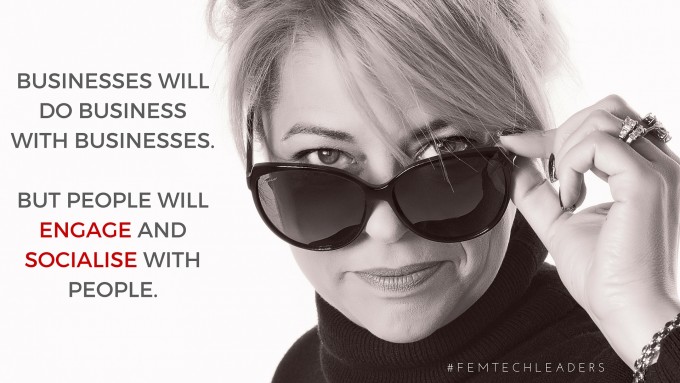
Unlike your corporate persona (if indeed you work for a corporation), which has to follow brand guidelines and governance requirements, your individual persona should be exactly that: individual. Businesses will do business with businesses. But people will engage and socialise with people. How many CEOS are now jumping on the bandwagon of social engagement and showing their human side? I’m sure everyone feels they can engage directly with Richard Branson, but do they feel the same about António Horta Osório (CEO Lloyds Bank)? The fact that I didn’t even have to specify Richard’s job is telling in itself.
You mentioned you mentor individuals quite frequently and routinely instruct the women you mentor that “you don’t have to act like a man.” Can you elaborate on this advice?
There is nothing that puzzles me more than speaking at conference and seeing an ocean of navy/black/grey suits in front of me. Of course, if that’s how you like dressing, that’s totally fine, but if you’re only complying with what you think is expected of you, then stop right there. Women are fortunate that they have so much more scope then men for their working wardrobe,so let’s embrace it! I will continue to talk about threat intelligence and extolling the virtues of distributed ledgers whilst perched on my six-inch Louboutins and wearing pink until such time as age prevents me from doing so (and I fully intend to grow old disgracefully, so it may be a long time yet). Of course, what you wear reflects your personality and that is a branding tool that shouldn’t be ignored. And as much as what you wear should reflect the real you, how you act is equally important. Act according to your own beliefs and emulate those characteristics you most admire in other people (and your own mentors play a big role in your development; I personally have five). These characteristics may (and should) change over time and a personal brand may become stale if it is not constantly re-evaluated. That’s the essence of continuous improvement.
You mentioned that when looking back on your career you don’t remember being a woman as holding you back. Now that you’ve had time to reflect, does this still hold true?
Yes it does. I’m not saying that I didn’t encounter discrimination at one point or another, because I am sure I did – be it age, gender, seniority or something else. But the principles of self-belief that I was raised with made me ignore discrimination in all its forms. I probably just didn’t notice and carried on my merry way on the path I believed was true. Of course, I made mistakes throughout my career, but learned many years ago that when faced with a brick wall, you have two options: put up with it, or get out. I am a change management practitioner and one of my favourite saying is: “If you can’t change the people, change the people. Sometimes it’s yourself.”
You noted your husband is your sounding board. How important are partners in an individual’s success? What value add can they provide?
Partners are extremely important. Friends and family are the most honest sounding board you have because they are not afraid of telling you the truth – bluntly. They will be there to celebrate the good times and pick you up when things are not going so well. I use my husband as a sounding board on new ventures, problems I face or anything else for which I need an honest opinion. And many of my friends have been the recipients of new PowerPoint presentations (poor them, but that’s friends for you!) before I inflict them on the public.
Who do you consider to be strong women leaders in the banking / FinTech space?
Eileen Burbidge and Gemma Godfrey have an incredible presence. Mélisande Mual does a fabulous job with The Paypers. Avivah Litan at Gartner is always very insightful. Lisa Shipley is an inspiration. There are many more fabulous ladies.
What do you see as the three leading future trends for FinTech?
I actually have five:
- Biometrics, because the need for serious authentication driven by recent technology advancements is undeniable. It will also be pushed by new regulation such as the new European Payments Services Directive.
- More mobile, leading perhaps to more wearables. After all, even in the UK, where plastic card usage is very high, 49% of payments are still conducted using cash. Plenty of scope still for cash displacement worldwide.
- Behavioural analytics and big data to deliver the transparent payments experience that consumers expect, whilst controlling fraud rates.
- API-driven services to enrich the consumer experience, wherever the point of interaction might be. British Airways recently announced that it is opening up its APIs for flight information and bookings to encourage developers to create value-added travel applications.
- Distributed ledgers (e.g. blockchain). Indeed, many large players such as BNP Paribas, Deutsche Bank, Citi and Barclays are already exploring its possibilities.
More about Neira:
I run my own consulting practice, and more than 20 years in financial services and technology has made me believe in change through innovation and partnerships. I’m privileged enough to be regularly invited to advise organisations of all sizes on payments, cyber risk, information security and digital innovation and I regularly address global audiences on these topics. I enjoy change and turnaround programmes as well as launching new products and services whilst always striving to demystify the hype surrounding current issues and raising awareness of important matters such as cybercrime and innovative technologies. I also derive a lot of satisfaction from mentoring people. I have previously worked for Barclaycard, Santander, Abbey National, Oracle Corp. and Unisys. My clients include financial services institutions, FinTech companies, consulting organisations as well as information security and technology providers.
I am on the City Am FinTech Most Influential Power List, was nominated a Top Influencer in Security To Follow on Twitter in January 2015 by Tripwire, Top Chief Security Officer to Follow on Twitter by CEO WORLD magazine in April 2014, and Merchant Payments Ecosystem nominated me Acquiring Personality of the Year 2013. I received the FStech April 2013 Compliance Project of the Year & Anti-fraud/Security Strategy of the Year awards, the 2012 SC Magazine Information Security Person of the Year award and I was inducted to the InfoSecurity Europe Hall of Fame 2011.
I enjoy interacting with people from all walks of life. I love cars and tech, and I’m proud to be female!

Join the conversation
© 2015 | FemTech Leaders
Archie Aikenhead - 1 year ago
Loved it. I learnt a stack of really good things from this. Thanks for sharing your thoughts
Harrison McKenna - 1 year ago
Awesome post. I learnt a stack of really good things from this. Thanks for sharing your thoughts
Neira Jones - 1 year ago
Thanks Harrison, glad it was useful!