Duena Blomstrom
Founder & Owner of DB Consulting
@DuenaBlomstrom | LinkedIn Profile
London, United Kingdom
You are good friends with Andra Sonea from Lloyds. You both are originally from Romania, both have successful careers in FinTech, both profiled as part of this initiative, and both were rather blunt on your experience as a women in this industry. What has been your personal experience as a strong, outspoken woman in Financial Services? What impact does growing up and starting a career in Romania shape your approach to business?
While I am fortunate enough to have many of those in the FinTechMafia and the FinTech scene in general as very close personal friends, Andra (who I met a few years ago through FinTech at a BarCampBank in Berlin!) is in a league of her own. I’m very fortunate to have her in my life and be inspired by her.
I only very briefly worked in Romania, I went to school in the States and was only back in Bucharest for a few years founding and heading a consultancy before I moved to Sweden where my career well and truly begun so it’s difficult to comment on being a woman in that environment whereas in Sweden it is a non-issue. I was definitely the beneficiary of the fact that Romanians are made of strong, resilient stuff and that being in Sweden meant I could hand my newborn to my programmer husband and fly right to a Finovate in 2011, but with that disclaimer aside and while I certainly met oodles of instances of male (and female!)-led discrimination of all sorts, it is not something that consumes me.
In fact, and this is a topic that comes up often at FinTechGirls nights out, I was in intentional denial about the feminist angle in our industry. I spent my entire career refusing to wear all black men’s suits, pretend I’m un-emotional and adopt rigid business jargon to make me fit in and if the industry penalised me for anything it has been my uncomfortable message not my gender. I don’t think it’s hard to be a woman. (Not in business, it is in general, we make infinitely long lists and impossibly high perfectionist standards for ourselves). It’s different and if worn with courage it can be an advantage as well. I think our rhetoric suggesting the industry is particularly hard to crack for women is unfair. Look at this superb initiative, look at the amounts of women in Top FinTech Influencers lists - blatant discrimination may well have been the case for pure Finance and the case for pure Technology but in their intersection, our new FinTech frontier we are reversing that trend.
The one area that gives me pause as to how things would have been different should there have been more women in banking is our collective abhorrent fear of the word “feeling” - maybe, just maybe we would have been more willing and courageous to use it and investigate it if there were more than 10% women in the industry.
Nonetheless, I am adamant that we remind women that to be in the industry does not mean they need to change and be men. It does not mean they need to check their intuition and their feelings at the door and allow men to dictate the tone of the debate. In fact, it would be immensely sad if they did.
You’ve witnessed first-hand the experience of seeing a small FinTech startup experience explosive growth during your time at Meniga. What do you believe attributed to the company’s success?
Meniga is an amazing story of a FinTech win. It’s so much easier to look like a unicorn when you are selling direct to consumers and the market can see the immediate advantage but Meniga took the hard route of effecting change in banking at scale by selling white-label to banks and then helping them understand new business models around data and customer relationship. It succeeded because it had an immensely strong product at the very core of all engagement strategies of any bank and an amazingly smart team who quickly understood knowledge of how to build these strategies was at a premium but it is still early in the second part of the mandate and moving away from simply selling PFM to actually enabling banking to alter their focus towards more lucrative fields like advertising, retail and identity management is not an easy task.
You often speak and write about ‘emotional banking’. Can you define this concept and why is it so important to the industry?
I left Meniga after transitioning from being Head of Sales to being their CMO earlier this year as I passionately wanted to focus on a concept we had arrived at while growing the PFM proposition - Emotional Banking, how to strive for EX not US, namely how to have banks stop and think of the intimate feelings consumers have about their money. It stunned me that this was not a major focus for any of the tens if not hundreds of banks I had met while with Meniga and was convinced this had a direct effect over how the products banks offer the consumers even in their digital form, are the least developed of all the products we interact with on a day-to-day basis.
At first I set up a workshop to force UX, Strategy, Digital and Innovation teams to think under terms close to Psychology 101 along with exploring concepts such as Empathy Design and Human Centred Design. Simple questions “What is happy money? What is sad money?” - “What does credit really mean to a consumer?” - “What are people’s Money Moments and how can we make Banking Invisible and contextually slide in and out of the consumer’s life?”. There is immense value in that workshop but it requires a team who is already on a path to be curious about the intimacy of consumer’s thought process and those teams are not the norm in banking sadly so I realised soon it all is about whether or not a bank is willing to become an empathetic, beloved, even addictive brand because if not they will never be serious enough about creating delightful experiences to probe into the consumer’s psyche.
I then realised banks don’t even understand the meaning of being a brand, they think it’s about colours in an ad campaign and some Marketing Manager should deal with it and can’t recognise that unless it is a DNA exercise that’s passionately upheld all through the organisation it will not be valuable. Which brought me to the crux of the issue. To why banks don’t honestly look at new business models, to why they are not intently curious about the consumers’ feelings and they dissociate and lack an ability to empathise with them, to why they are unable to build really addictive brands on an axiom of lasting attachment - the bank can no longer “passionately uphold” anything. It’s too big, too afraid, too mindless and too heartless as this new mammoth entity - the organisation. It speaks wooden, tired language with little revelation or truth contained. It moves slowly because of old backend systems and regulation yes but also and ultimately because it incentivises its people wrongly, it rewards them for getting intellectual vertigo and rewards longevity not courage, it takes talent and enthusiasm in and delivers lack of real interest and complacency on the other end.
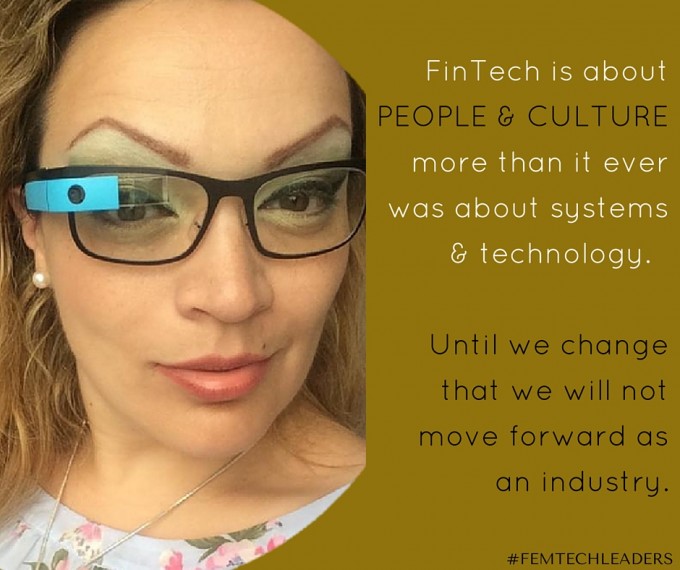
This all sounds slightly melodramatic but if we’re honest very few of us would disagree. It’s about people and culture more than it ever was about systems and technology and until we change that we will not move forward as an industry. Some would argue being a massive corporation is equally bad in any industry but I believe that’s not the case. Most other ones who have direct rapport with the consumer such as Retail may have issues but they don’t run as deep as to disallow them from understanding the power of branding and relationship. Others that are remote from the end user that they don’t need that exercise and the fact that the structure in a Manufacturer rewards lack of curiosity won’t affect the consumer. Banks are more of a Retailer than they will ever be a Manufacturer and they need to wake up, smell the change roses, clean house, build brands and think of consumer’s feelings about money in the process.
You are a sought after speaker on the FinTech conference circuit. What are your personal key themes you enjoy speaking on?
I speak about the threat to banking like everyone else does because we all understand the imperative of the historic moment for banking but I look at it from a different perspective as I said above. I strongly believe banks need to do some deadly serious investment in people and culture change real fast to enable them to either get smart about building a real Facebook-level relationship with the consumer before they leverage on theirs or to do honest analysis as to what business models are there to be found in becoming a pipe for them.
What the key messages both banks and startups must be focused on in your opinion?
I think startups in FinTech or not should look at banking as a history lesson as to what is going to happen if you grow and don’t keep having the right people and the right ethos as your true religion.
Do you believe most FinTech conferences have ‘jumped the shark’? What type of conferences are your favorite to attend and why?
I’m a Finovate addict and always will be. I’ll be informing my Florida old people’s home staff that they need to wheel me into at least London and NYC for the remaining few editions I’ll attend. I can’t imagine how anyone can get bored of it - not only is it actual demos of products you know these teams believe in passionately but it’s showcasing the cycle of innovation in Financial Technology.
I’ve also been a fervent supporter of the Next Bank and Bank Innovation events over the years and while I’ve attended a Money2020 and a few other huge mainstream ones I’m still most excited about the new formats coming out such as Data Natives and CX Ireland none of which was FinTech only but combining the themes that matter - data or the consumer.
Are we in a tech bubble?
We are in a FinTech bubble. And I’ve been in my own so tightly I no longer feel qualified to answer if that bubble applies to all of Tech or not but I suspect it’s not the case.
You are an active mentor and board member for several FinTech startups. What do you focus on when working with these organizations?
I’m a mentor, advisor and board member yes but I’m also an Angel Investor in some so my involvement is far more viscerally important to me. When I choose where to put money and time I look at product of course, and at team as well but most importantly I look for the same qualities in the leaders that I like to see in what I call “the real FinTech Unicorn” - bankers who made a difference - BB&H which stands for “Brains, Courage and Heart” and I’m strict in not letting myself get involved if any of these three is not strong.
Who(m) do you believe has had the most influence with respect to your own career?
That’s a difficult question. While they can also frustrate me to tears at times, I’m in awe of each and everyone in the FinTechMafia in different ways and have learned a lot from all of them not to mention owe them a great deal on a personal level having had their support and friendship for the past few years. Outside of it, there are other people I’ve been lucky enough to meet who have been instrumental in my understanding of the space and have left me with more insight than they have intended to at times. I won’t name any names but I will say the FinTech community feels like family at times which is either amazing or terribly sad depending on how you want to look at it:)
Who do you consider to be strong women leaders in the FinTech space?
Your initiative covered mostly everyone I know, love and respect (and I know some more amazing women are in the process) except maybe a few names such as Santander’s Rut Prada, Maite Aguilera and Shaloo Kulkarni, ING’s Almudena Roman, Meniga’s Eleni Vlami and Unicredit’s Claudia Chiaraluce who are all doing great things behind the scenes and changing the industry in great ways.
What do you see as the 3 leading future trends for FinTech?
How far is this future?
A whole new experience layer for the consumer is certainly coming. Invisible Banking with its many constructs of Money Moments ™, context and relevancy, new banking products, identity models, digital currency, robo-advisory and so on are all in the cards. Undoubtedly our children will be a generation where money will become the invisible life enabler it should have always been and all this nightmare digital and physical experience based on artificial product constructs will be long forgotten. I don’t share Brett King’s optimism at this happening over the next 10-20 years though.
I think that short term future will see the industry in a last innovation-scramble-sprint which is what I call the inflation of labs, incubators, accelerators and other -tors and likely in a period of serious consolidation around the type of technology and type of proposition. This consolidation may or may not be dictated by the incumbent banks depending on how burning their change imperative becomes and that will be dictated by when the giant “Tech”s decide to add “Fin” to their name.
More about DB Consulting:
DB Consulting does Digital Strategy for banks and FinTech acceleration by day, and Emotional Banking and Cultural Change by night. That’s the only way to describe it accurately. If the night job would be something so main stream that banks clearly understood they need and were prepared to do something about, the day job would not be needed but realistically, the concept of EX (Emotional Experience) in lieu of UX, that of building strong brands for banks and helping them change their DNA to where understand their clients intimately is still well ahead of its time and we are not in the fastest of industries.

Join the conversation
© 2015 | FemTech Leaders
ger heffernan - 1 year ago
Great article,we need more women in business like you