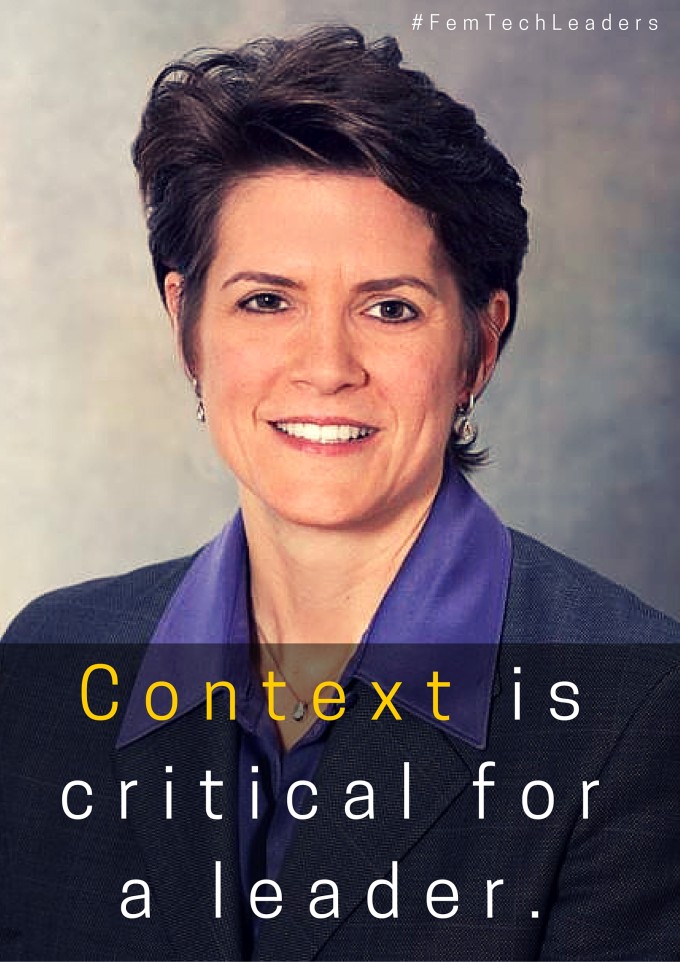
Renee D. Brown
SVP, Director of Social Media, Wells Fargo
Charlotte, North Carolina
@ReneeDBrown | LinkedIn Profile
Please provide a summary overview of your role at Wells Fargo.
Today I lead Enterprise Social Media which includes the development and implementation of enterprise social media strategies. My team runs point on team member social engagement, social listening, analysis, marketing, new trends and partnership on social care practices across the company.
Your first job was in radio. Can you elaborate on this experience and what lessons apply to your current role at Wells?
Being a radio announcer and airborne traffic reporter for nine years taught me the behind-the-scenes workings of an important media format in that time period. In addition, the attention to the use of time was foundational to the type of leader I am today. In radio, every second is critical. As a reporter, I often had 30 seconds to clearly transmit 5 minutes worth of information. So, learning to boil a message down to the most critical elements (for the audience) is quite similar to the challenge of working on 140 characters in social media. Being succinct is something not enough folks are taught prior to entering the business world, yet it is a commonality you will find among strong executive leaders. Radio taught me the 30 second elevator pitch is something everyone should use all day, not just on air or in elevators.
You have an extensive and broad work experience at Wells Fargo with a strong marketing emphasis. How does this impact your approach to social media?
I am a business leader first and a social media leader secondly. I have that perspective because of my years supporting many different businesses, brands and cultures. Context is critical for a leader. Leaders who have years of experience will come across a business situation that is new, but it usually has characteristics of other similar situations they have faced. Those many years of experience provide a mental muscle memory around how something from the past that may apply to the present and can shape the future. As one famous quote has said, if the past does not repeat itself, at least it rhymes.
How do you believe technology and social media have impacted brand management?
Social media and advancing technology has handed the balance of power from corporations to consumers. Many changes are underway because of this shift. The expectation of being transparent is now the norm, 24/7 access is the norm, companies must be in channels important to our customer (not us), it blurs personal and professional lines, and assumes personalization (knowledge of the customer). All of these are huge changes for large corporations.
How did you go about building your current team at Wells?
The mission in building our Enterprise Social Media team was to bring in young, diverse, digital-natives and teach them about Wells Fargo, learn from them, and then move them into the company. This role is the first time I have been able to serve as a ‘seeder of talent’ intentionally. I was deliberate in seeking all forms of diversity from gender, to race, to age to thinking style. My lesson in that is that it is far harder and takes more time to manage a truly diverse team than a homogeneous team.
You are an active support of and Board Member for Out and Equal Workplace Advocates. Can you elaborate on this organization? What similarities do you see with this organization and the overall issue of gender diversity?
The Out and Equal Workplace Advocates organization works to help equip large companies to provide a welcoming workplace for LGBT professionals. The international area is growing and quite complex. In addition, the Transgender work continues moving ahead, but is still quite difficult for companies to manage. A similarity to gender diversity is the element of being counted. For companies anything that is not counted, does not count. For women, often we are the majority of lower level roles but not senior positions, the impact of this sometimes is hard to quantify. For LGBT, many companies still do not allow self-identification and therefore the group is not counted in other diversity work and opportunities. Much progress has been made and I look forward to being part of progress in months and years ahead.
Who(m) do you believe has had the most influence with respect to your own career?
My father. While that may seem sentimental or expected, he was a role model for an extreme work ethic. In addition, he was a man of few words when it came to pep talks. However, the one thing he always told me is “you can do anything you put my mind to” because I am so…he would say smart and I would add stubborn. I have held that phrase from him and anytime a new opportunity arises, I hear his voice in the back of my mind and I go do something new. Thanks Dad.
Who do you consider to be strong women leaders in the FinTech space?
What do you see as the 3 leading future trends for FinTech?
Consolidation of technologies to make customers lives’ easier –payment solutions, to peer to peer financial solutions, new aggregation tools, new authentication tools, etc. In addition, I expect many advances on protecting consumer identities in the high tech age. It is an ongoing problem needing better solutions so that should emerge in short order.

© 2015 | FemTech Leaders
Start the conversation