Carolyn Homberger
Group President - ACI On Demand at ACI Worldwide
Naples, Florida
@PaymentsChic | LinkedIn Profile
Please describe your role at ACI.
I am Group President for ACI On Demand (AOD), which is one of 3 P&Ls (Operating Divisions) at ACI Worldwide, a leading global provider of payments and banking solutions. I am a member of our Executive Leadership Team and report directly to our CEO. In my role, I am responsible for growing and operating ACI’s Platforms & Software-as-a-Service (SaaS) businesses, which represent 40%+ of the company’s revenues, which are now north of $1 billion annually. I directly manage AOD Sales, AOD Implementations & Customer Experience, AOD Operations & building our Strategy for the business unit.
You have extensive experience in the healthcare space. What led to your interest and career in payments? How different do you find the two industries?
I started my career in corporate finance with General Electric’s Healthcare business and always had a passion for healthcare as both of my parents worked in the industry. I accidentally landed in payments when I followed the CFO I worked for to ACI Worldwide. I immediately fell in love with the payments industry as it was so diverse, dynamic and ripe for disruption! It was obvious to me that technology would have a profound impact on how we exchange value as consumers and businesses, and I couldn’t think of a better industry in which to grow my career. In terms of how payments compares to healthcare, I have found a number of parallels. First, regulation plays a major role in healthcare, for good reason, and I learned early on to embrace work with these constraints imposed on the business. Also, the speed of change in healthcare and the role of technology have been game-changers in helping drive discussion from reactive to early detection. Finally, the need to deliver an individualized, human experience at large scale in healthcare accurately describes many of the challenges in payments.
You led the efforts to establish ACI’s Women Initiative program. Can you describe the approach taken in creating the program?
I started ACI’s Women’s Initiative (WIN) almost 2 years ago. I was inspired to do this when I was visiting one of our ACI offices and had to pump as I was breast-feeding my second child. I knew that one of our administrative assistants had also just had a baby and was breast-feeding, so I asked her if she wanted to take a pumping break together. I was absolutely shocked to learn that she pumped everyday sitting on a toilet in a restroom as there was no private space to breast pump. As the most senior woman in the company, I felt deeply responsible for encouraging a work environment where women felt comfortable speaking up and addressing issues impacting their ability to do their jobs. I wrote to 10 women in various roles across the company and 6 months later, we kicked off the ACI WIN. We currently have 300+ members globally across the company. We sponsor the Women in Payments Symposium and have hosted a number of networking and leadership development events for both men and women who work for ACI.
What are the key lessons you learned in launching this program?
The three most important lessons I learned were making the call to action “personal,” the issue of gender diversity still meaningfully impacts our work environment today and the reaction of men. We are all very busy with our lives and our jobs, so when I introduced the WIN, it was important to ensure it was meaningful to our company, to the industry and the participants as I recognized that the time was going to be largely volunteered. Many women at ACI have stepped forward to lead coaching sessions, participate on panels and advocated tirelessly for women at ACI. I have been equally surprised by how many men and women leaders have stepped forward encouraging me to continue to speak up on the topic of diversity and growing ACI’s WIN. It has been repeatedly reinforced that unless we keep “talking” about this challenge and holding ourselves accountable for progress, we will not change as an organization or industry. Finally, many men make it a point to attend WIN events and share with me that they hope for a work environment that is supportive of their wives, daughters, sisters, etc. They actively participate and are supportive of the effort.
You are an active member of the Women in Payments organization. Can you describe how you became involved?
I currently co-chair the Board for the Women in Payments organization with Jan Estep, CEO of NACHA. I became involved with the group when I went to ‘google “women’s organizations in payments” as I was creating the ACI WIN. This was the only organization that spanned the Payments eco-system, which ACI serves, and I sent an email to Kristy Duncan, the founder, to introduce myself. She invited me to her symposium in Canada and I was overwhelmed by the participation, breadth of experience in the Payments Industry represented and seniority of women in the audience. It was such a great experience that I encouraged Kristy to start a symposium in the U.S. and ACI became a founding sponsor. Kristy has been a great mentor, having such deep experience in payments, and introduced me to many women who share the same passion I do for improving gender diversity in payments.
Do you believe the gender diversity issue in FinTech is improving?
YES! I believe the gender diversity issue is improving in FinTech, but we should by no means slow down! From when I started with ACI 9 years ago, we have made tremendous progress, increasing both the percentage of our employee population who are women (35%) and the percentage of women in key senior leadership roles (25%). Further, forums like the Women in Payment’s Symposium and company or industry-sponsored affinity groups have increased the dialogue on the topic. Finally, the importance of partnering in FinTech across the payments ecosystem has become critical to growing. In many ways, this plays to women’s strength in leadership, encouraging collaboration and active participation.
What specific steps do you believe both organizations and individuals can take in addressing the gender diversity issue in FinTech?
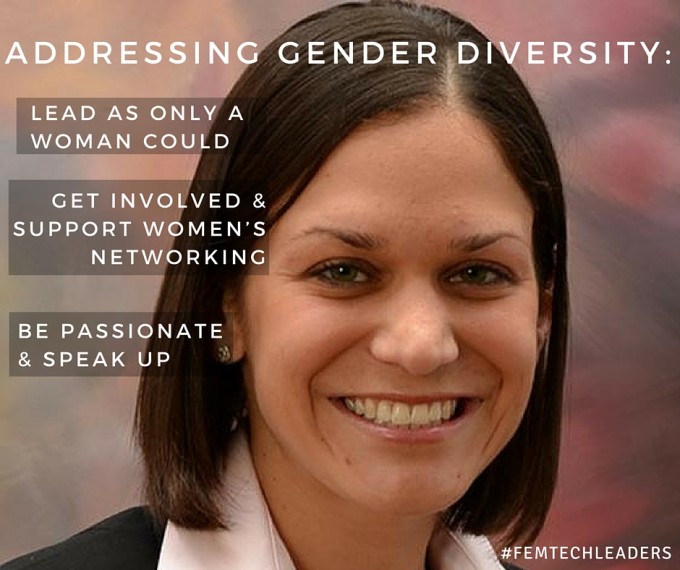
I would provide 3 recommendations on ways that organizations or individuals can address the gender diversity issue in FinTech. This includes:
- Lead as Only a Woman Could; Women bring a unique perspective and leadership style to the industry. I believe this is valued, needed and improves the overall professionalism of payments. As the industry contends with disruptive technologies and security concerns, women can bring strengths to the table including collaboration, creativity and compromise.
- Get Involved and Support Women’s Networking in Payments; Women’s forums have provided me an incredible opportunity to establish relationships with key Women Leaders in Payments. I believe openly discussing the gender imbalance across the industry leads to awareness, which leads to action.
- Be Passionate and Speak Up; Anyone who ever made a difference had passion. Be courageous in advocating for women and openly encourage or celebrate women’s accomplishments in our industry.
Who(m) do you believe has had the most influence with respect to your own career?
I will highlight three people who have most influenced my career. First, my mom because she is always honest with me, served as a great role-model and advocated for me tirelessly. My mom was a huge supporter of and very involved in my education. She was and always is there for me when I need her. Second, Kelly Kramer, who is now CFO of Cisco. I had the good fortune of working with Kelly early in my career at GE Healthcare. Kelly demonstrated that it was possible for me to have both a family and a career. She led with energy, personality and invested in people. She was a fantastic role model early in my career and though it has been many years since we have worked together, she is someone I look up to as her career has progressed. Finally, ACI’s CEO, Phillip Heasley has been an invaluable mentor and coach. He is visionary, experienced in transforming businesses and constantly challenges my thinking. Phil has repeatedly given me the opportunity to work on large, complex initiatives that meaningfully impact our business and customers—even when I did not have all of the experience and skills to do the job. He gave me the opportunity to learn, grow my career and surrounded me with incredibly talented people who have supported me in this journey. I am very fortunate to have built my career at ACI Worldwide.
Who do you consider to be strong women leaders in the FinTech space?
I will highlight two women with whom I have worked most closely, Jan Estep, CEO of NACHA and Amala Duggirala, EVP of Application Development at ACI Worldwide. Jan has a very distinguished career in payments and is well-networked in the industry. I admire Jan’s ability to set a transformational vision for NACHA and influence the industry so meaningfully with the move toward Real Time Payments. Jan also goes above and beyond her role by investing her time in organizations like Women in Payments.
I have the good fortune of working very closely with Amala Duggirala, who leads ACI’s very talented 1,000+ employee software architecture and engineering team. Amala’s ability to build and deliver world-class payments technology is unquestionably the best in the industry. I admire the way she leads her team and balances the needs of business leaders like myself as well as the needs of a large technology organization. Amala pushes me to do my job better every day, is supportive of my efforts in growing our business and is a key person I seek out for advice when I am making an important decision.
What do you see as the 3 leading future trends for FinTech?
I believe the 3 leading trends impacting FinTech will be empowerment of the retailer or biller, application of block-chain or distributed-ledger technology to payments and the impact of the generational shift on the customer experience. New payments technologies and eCommerce have opened the doors for retailers and billers to provide considerably more choices for payment to their customers. There have been some exciting use cases like the Starbucks App, which have proven that linking mobile payments with loyalty or rewards programs can drive a substantial shift in consumer payment behavior. I believe payments will continue to commoditize and fade into the background, while the retailer and biller customer experience will prevail.
Next, I do not believe that virtual currencies will grow meaningfully in the long-term; however, the technology and concepts present incredible opportunity to disrupt the P&L of payments.
Finally, the generational shift of “Millennials” gaining increased purchasing power (consumer and business) will substantially impact the customer experience. Millennials will force much-needed investment in real-time payments infrastructure and continued investment in the digital payments experience. Migration to a true Omni-channel experience will impact retailers and billers as well as financial institutions. FinTech companies providing consumer or business technology experiences that are simple, intuitive and aesthetically-appealing will win.

© 2015 | FemTech Leaders
Start the conversation