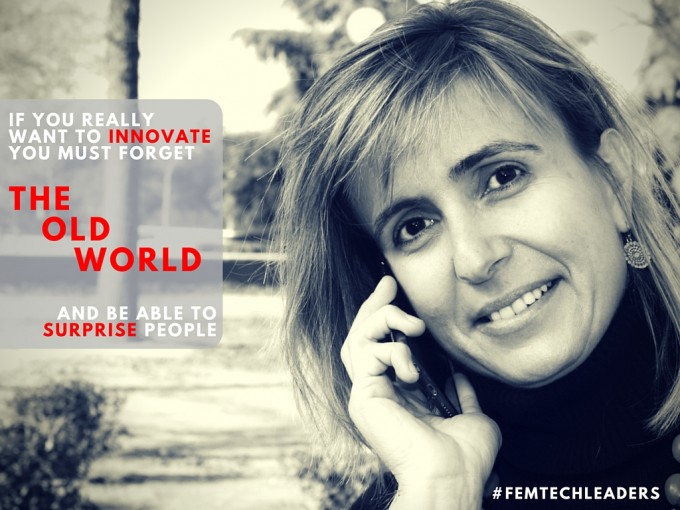
Rut Prada
Director, Innovation Area at Santander Group
Madrid, Spain
@bancosantander | LinkedIn Profile
Can you please provide an overview of your role at Grupo Santander?
I work in the Innovation Area of Grupo Santander designing and building new customer solutions aimed at building the Bank of the Future thru Design Thinking, Agile Developments and Lean Startup approaches.
My role is to identify, develop and test new solutions within and outside the financial industry, that combined in multiple different ways could allow us to create strategic innovation and even new business models that could change the way we perceive Banking in the XXI century.
Quite different from when I started, 10 years ago, in Santander Group. At that time, I was hired as the corporate responsible for the technological internet developments that were necessary in order to integrate the technologies of the Banks we have acquired in UK, Germany and in the US. Those integrations were aimed at gaining efficiencies and there was little space at that time for many innovations or improvements in the customer experience of our new clients.
Those were difficult times, a lot of pressure and work, but we had very strong leadership, and we were a “full army”, coming from all the areas of the Group, working together towards the same direction.
Then “war times” came to an end, and we realized it was time to keep up with the world and move forward to where many of our competitors were positioning themselves in terms of technology, customer centricity and methodologies.
At that time, I moved to the Corporate Technology and Operations Area (T&O), where I specialized in Digital Customer Experience, analyzing, defining and building solutions in the field of Mobile, Digital Wallets and Personal Finance Management (PFM) for our retail customers and universities.
I am one of the few persons from T&O that have been chosen to be part of the Innovation Team, a totally new world where I am having the opportunity to open up to the outside world and be part of the FinTech space.
Early in your career you managed a multi-cultural team (Slovak-Uruguayan-Spanish) for adaptation of a Spanish Commercial System. How did this experience prepare you for your roles in financial services?
When I started my career, in 1991, with only 21 years old, I had the opportunity to go and work during two years, in Bratislava, Slovakia (at that time, Czechoslovaquia), to be the responsible of the software development of one of the modules of the new commercial system for the main electricity supplier company of the country.
It was one of my most exciting work experience, I have 5 persons in my team which did not even speak English and most of them doubled my age; when we talked to our users, we had to define and negotiate new requirements with the help of translators. In our daily activities, even buying my first car or going to the supermarket was an adventure since you never knew what you could find in there. The whole country was beginning its political and economic transformation which could be felt everywhere.
At that time, the customers were really the focus of our work, and we use technology to change their way of life. We teach them thru a lot of education how to use direct debits as a new form of payments which let them to better manage their time, instead of having to spend hours in queue at the branches to pay their bills.
It was amazing to be able to improve people’s lives, influence the way they perceived the company, and the way they related to them.
Some years later, I had another remarkable experience when I worked for a new model of real estate’s company. Even though our main objective was to sell houses in the south of Spain to North European people, what we actually did, was define and include with the house, all the services that a person could have from the early age of 55 to the end of his life. In order to do that, we analyze the different stages of his life to identify all the needs those persons could have: maintenance and cleaning services for his home, medical needs with a medical center, a hospital and a geriatric center, sports with golf courses, leisure activities, restaurants, transportation, etc.. Again we were focused entirely on our customers and through the mapping of their customer journey during those years, we built a new different business model around the real estate offer.
And then I got many other different projects during my consulting years, some related to the improvement of internal processes within companies, others related to customer relationships improvements in different sectors (Travel, Hospitality, Education, …) and I learned (the hard way), that you cannot use technology to make people do what you want to do. Technology should be a facilitator but never an end in itself.
Back now in 2016, working in the financial sector, when I hear or read about the importance of customer centricity, it reminds me of those times in Bratislava and in the Real Estate ‘s Company. In the last years, the banking industry has been worrying too much on how to sell their financial products to their customers.
Those past experiences have prepared me to think and really worry on understanding what are the customers’ real needs and how to be able to help them. I learned that in order to define better customer experiences you need to be able to get on your customer’s shoes and focus on what they want to do and how they are feeling about it.
You studied science and business administration at university. What led to your career in financial services?
When I was little, I wanted to be an entrepreneur, that is why I decided to study Business Administration in Boston. But then, when I came back to Spain, I got my first job, my first salary, and then I got my two kids. I started having financial needs, looking for financial stability and the aim of my life changed to other things more important than my childhood dreams, and that kept me working with lesser risks.
During the journey, I learned that working for others could also be fun and exciting; as long as you can make changes to people’s lives, and you keep growing as a person, while continuing to learn and meet new people of different cultures and different sectors.
Before I joined the Financial Services Sector, I worked more than 5 years in Arthur Andersen, in the Leisure, Travel and Hospitality sector, thinking how fortunate I was, since I thought at that time that it was more fun to visit Hotels, Theme Parks and Travel companies than visiting Banks, which I considered rather boring at the moment… (How ignorant I was…)
During those years, which were hard at a personnel level, I was called by one of my mentor and friend from my consulting years, to work for Santander Group. It was a time where Santander was buying banks all over the world, technology was one of its main drivers in the integration. They were looking for new and fresh ideas, new multicultural skills, people that could enhance the role of Technology & Operations within the Group, people with a more functional background. It sounded exciting…So I went for it and my career in financial services started …and until now there have been more exciting than boring moments as long as I can remember…
Building new customer experiences for the Financial Sector can be as challenging or even more than in other sectors. We cannot forget that when we manage people’s money, we are managing one of their most precious assets in life.
You were tasked with developing an innovation team at Santander. How did you go about putting the team together? What were some of the key lessons learned from this experience?
When I started working in the Innovation area, my main objectives consisted basically in building innovative solutions for the Bank of the Future while changing the way we used to work.
I was assigned the exciting task of being one of the first one to develop a new product within the innovation area: building a new digital experience that would allow our potential customers to improve their lives having the control over their finances.
In order to do it, I had to put together from zero, an innovation team, composed by people from one of the leading PFM FinTech at the moment based in Islandia and London; different local teams for the design and development tasks, and business people coming from different areas of the bank, all working together in our recent inaugurated work spaces in Boadilla, Madrid.
We had a scrum master, conducted daily meetings, even did poker planning estimations with our mobiles, did design thinking sessions, use crowd testing techniques. Learning and experiencing all the time total new ways of working, with new people and enjoying ourselves during the journey.
The beginnings were difficult since they implied new facilities, new ways to hire contractors, new technologies, new infrastructures, new mindsets for designing, new relationships with our banks and colleagues from the rest of the corporate areas. We went from belonging to a Unit of more than 10,000 people, to just work 15 of us having to know about almost everything and using our personnel relations to get help from the rest of the areas. Sometimes, it made you feel very lonely, even being part of such a large Group
But the journey was worth it and fascinating: this kind of working environment where you work closely with the teams, being able to motivate them, share with them ideas, achievements, listen to their proposals and execute them, feel their sincere commitment and enthusiasm. All this is also part of innovating, even if it is done at another more internal level.
In this environment you are able to take almost all the decisions around the Product you develop, and see how it comes to life. It makes you feel as if you were an entrepreneur (as I wanted to be as a child!)
During our interview you stated “You have to be able to forget the old world” when you described managing a bank innovation team. What did you mean by this?
By “old world” I mean, a world characterized by a very strong and rigid cultural background, probably influenced by Spanish traditions, where hierarchies are important, business people wear ties and believe they rule the world. It is even used to be a world of men, where very few women succeed, less than 30 % are on top management positions in Spain.
In Banking and in Santander, the “the old world” represents also regulations, central bank reporting, a strong brand and reputation safeguard, minimum risks, zero tolerance to errors, solid branch networks, traditional methods of work, yearly budgets and objectives. All the things that allow us to maintain our customer trust and respect, our identity, safety and heritage.
In Innovation, you need to understand this “old world” of the banking industry, but you need to forget the old way of managing teams:
- You need to be open minded and accept others ideas, even if they seem crazy or stupid.
- You need to forget about hierarchies when designing solutions.
- You need to think more on customer needs than on products.
- You need to work with multicultural teams coming from small and big companies, motivate them and create a team out of it, respecting everybody and making them participate on the decisions.
- You need to learn to be more efficient, being on your own most of the time,
- You need to acquire new skills: business people learning about technology and technology people learning about business models
- And most important you need to have courage and take risks. You cannot go about asking permission to every single area of the bank in order to take a decision or test something.
Therefore, yes, in order to succeed in Innovation, in order to be able to define new business models, you need to forget the “old world”, which is very difficult because at the end, we are part of a BANK and to test our solutions within one of them, we need to obtain the validation from the different business areas of that bank (compliance, legal, marketing, brand,…), and to do this you need to struggle against their “traditional” mindsets and it is a process that takes a long time and can even led you to redefine your initial product.
What do you consider to be the key change in the relationship between banks and consumers? What is driving this change?
I believe the key change in the relationship between banks and consumers will come from the use of technology and from the understanding of what is driving emotionally our customers.
Technology has changed the way we interact with our friends, our family and even with the companies and the brands. When we lose our mobile, it is a complete disaster in our life, it even generates anxiety in some people.
Because of technology we have more knowledge (google is always there to help us…), we have a bigger network of friends (old schoolmates or colleagues we haven’t seen for years) and we can chose the time and place we want to interact with the rest of the world, included companies.
In the past, in the banking industry, people needed to go to the branches, they used to talk person to person, at branch opening hours, and about banking products most of the time. Not anymore, now you almost do not need to go to a branch, and you can check or manage your money at home or in any place and at any time you wish.
In the emotional field, there is a lot of work to be done yet. I believe that banks should understand the needs and life events of their customers in a particular moment in time, they should even try to discover what is their emotional state at that moment.
I remember when my kids were little and I was looking for a doctor for their routine checkups, I was more interested in finding a doctor that could also spend some of his time giving me advice and teaching me on how to better take care of them, than a doctor with the best reputation, that was so busy he could only talk to me for a short period of time and about “medical technicalities”.
In banking it should be similar, we should have people and technology advicing and teaching our customers on how to make a better use of their money in every stage of their life depending on their specific circumstances.
We should focus on anticipating their needs to help them, build solutions that meet their digital expectations and learn to speak about emotions with them. And we should start doing this when they are still teenagers, when they have their first digital experiences and their first money needs. We should become part of their financial education along with their first steps in the digital world.
For that, we have to build new digital experiences, we need to teach our employees more “human” skills so they can learn to get more close relationships with our customers. We have to use the tons of information we have in order to understand and anticipate their needs. We need to define new spaces built not only for the high level segment but also spaces to encourage more emotional conversations.
Who(m) do you believe has had the most influence with respect to your own career?
My father, who has been an entrepreneur and a visionary man all his life. He has taught me how to work hard and fight for what you are looking for, the importance of having local social networks to do business, how to be always ahead of times (he became one of the first mobile phone distributor in Spain and one of the first one to create a web company, among his other businesses around the consulting industry).
Since I got my first salary, he encouraged me and let me participate and learn in some of his crazy startups (as the one producing and selling Jurassic Park boots 20 years ago).
Even today he still surprises me when he teaches my kids that his job in the consulting firm was selling INTELLIGENCE to others - not products or solutions, not only projects or technology -.
From him, I have this continuous need to always keep learning, to try to be in advance of my times, and keep fighting for what I want. And besides him my mother, without her this could not have being possible either, since she has always been there, supporting me and giving me the freedom to be able to be myself and follow my own way.
Who do you consider to be strong women leaders in the FinTech space?
I have just recently start being involved within the FinTech space, but one of the strongest persons I’ve met is Duena Blomstrom. I met her when she worked at Meniga, and we were choosing a PFM software in the Bank. After 2-3 years trying to build my own PFM solution and convince the banks to include it in their budgets with little success, the time finally came in the form of a FinTech and Duena Blomstrom.
I share her passion for emotional banking, her Money Moments. I believe that the only way to be really innovative is being able to surprise people and this can only be done if we get deep into their emotions.
Probably with Duena’s energy, vitality and fighting we will come up to it, some day.
What do you see as the 3 leading future trends for FinTech?
The 3 leading future trends I see are:
- Strong shifts that will happen in customer experience. In order to succeed we need to change the habits of the persons and we have to do it by educating our customers and reaching their emotional senses. We need to teach them how to make a better use of their money without having to worry about their finances.
- Programmatic marketing techniques applied to the Fintech industry. I believe, even if the name could change (this happen all the times this last years), all the intelligence behind these techniques can be very useful in order to exploit the tons of data we have and create insightful platforms. “Real time bidding” techniques could help us give better advices and solutions to our customers at the right moments.
- Virtual Reality (even if we still have to see how it can be applied to financial industry, probably through “in-payments”). I think it will change the way we see the world, it will allow many people see and “go” to places they have not had a chance to go to (because of their health or lack of money), they will be able to experiment new emotions and most important be surprise about new things.
And that is one of the key drivers for working in the FinTech space or anywhere else. The ability to create something that can change people’s habits, that can surprise them, make them feel more alive, and by doing so being able to improve their lives.
More about Santander:
Banco Santander (SAN.MC, STD.N, BNC.LN) is a leading retail and commercial bank, based in Spain, with a meaningful market share in 10 core countries in Europe and the Americas. Santander is the largest bank in the euro zone by market capitalization and among the top banks on a global basis. Founded in 1857, Santander had EUR 1.51 trillion in managed funds, 13,000 branches and 194,000 employees at the close of 2015. In 2015, Santander made attributable profit of EUR 5,966 million, a 3% increase with respect to the previous year.

© 2015 | FemTech Leaders
Start the conversation